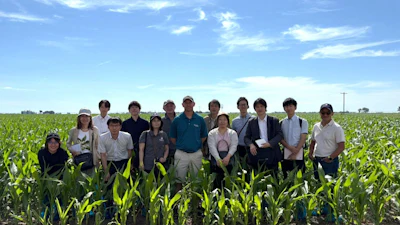
The U.S. Grains & BioProducts Council escorted Japanese corn millers and journalists to Nebraska and Iowa last week to examine sustainable farming and grain handling practices and learn about the Council’s Corn Sustainability Assurance Protocol.
Tommy Hamamoto, USGBC director in Japan, led the program with USGBC Director of Global Sustainability Carlos F. Suárez and USGBC Japan Program and Administrative Manager Michiyo Hoshizawa.
The delegation began in Nebraska, touring facilities operated by USGBC members Cargill and POET to observe how U.S. feed grains move from farm to customer. The group visited the Daugherty Water for Food Innovation Campus and Valley Irrigation to examine sustainable practices in U.S. agricultural production.
In Iowa, Corteva Agriscience hosted the delegation at its Johnston office to discuss how biotechnology has reduced inputs and environmental costs. The group also visited Iowa Corn’s headquarters for an overview of corn production and research programs in the region.
Farm visits in both states allowed attendees to meet U.S. growers and observe production practices at various scales.
“Japan is a mature market that has been a strong trading partner for the U.S. agricultural sector for decades, and continuing to adapt to customer needs will ensure it remains a dependable export market well into the future,” Hamamoto said.
Hamamoto said sustainable grain production advances through practical, on-farm practices like cover cropping, no-till, nutrient management, manure-based fertilization and precision irrigation. Japanese buyers now understand that sustainability in U.S. agriculture is a strategic business approach that improves productivity, profitability and long-term resilience, he said.