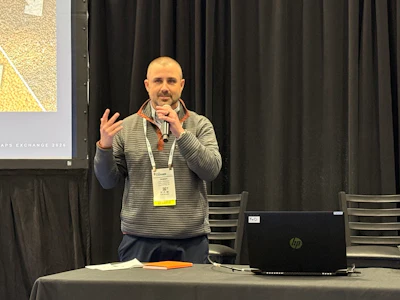
At GEAPS Exchange in Kansas City, grain merchandising specialists Roger Gattis and Jason Wheeler of White Commercial Corp. offered a crash course in the fundamentals that drive elevator profitability — and why understanding them matters even for those who never sit at a trading desk.
Why grain elevators exist
At its most basic level, a grain elevator exists to solve a timing problem. Grain is harvested once a year but needed year-round, so it has to sit somewhere in between. That physical storage function alone makes elevators an indispensable link in the agricultural supply chain.
"Grain comes once a year, but it's needed all year long evenly, so it's got to sit somewhere," said Wheeler. "This is a middleman in the world that we can't ever get rid of."
But there's a second, equally important function: bridging the gap between farmers who want high prices and end users who want low ones. This is where grain elevators diverge from virtually every other middleman in the economy.
Wheeler compared it to a furniture distributor, who has to extract margin from the price at every step of the supply chain. On the other hand, a grain elevator, through hedging and basis trading, can buy grain from a farmer at a high price, sell it to a feeder at a lower price, and still turn a profit — without taking money out of either side's pocket. That counterintuitive reality is the foundation of grain merchandising.
Key terminology
- Basis is the difference between the local cash price and the futures price — always calculated as cash minus futures. A local cash price of $4.00 against a Chicago Board of Trade futures price of $4.50 yields a basis of 50 under. Basis reflects local grain movement, not simply local supply. Gattis highlighted that even a bumper crop won't push basis lower if farmers aren't selling — the market responds to grain that's actually available, not grain sitting in a bin.
- Futures serve as a benchmark price that reflects global supply and demand conditions. Elevators use futures not to speculate on price direction, but as a hedging tool to eliminate price risk from their operations.
- Hedging means taking an equal and opposite position in the futures market to offset a physical grain transaction. When an elevator buys grain, it sells futures as a placeholder. When it sells the physical grain, it buys those futures back.
 Roger Gattis, grain merchandising specialist, White Commercial Corp. Elise Schafer
- Basis margin is what the elevator actually earns. Once hedged, the elevator has locked in the spread between what it paid the farmer and where it sold the futures. Improving that spread over time — buying low basis, selling high basis — is the core of grain merchandising.
- Carry vs. inverted markets describe the relationship between futures contract months. In a carry market, deferred months are priced higher than nearby months, signaling that the market will reward you for storing grain. In an inverted market, deferred months are lower — a clear signal to move grain quickly.
"An inversion is a market structure that penalizes you to carry owned grain basis ownership into it," Gattis said.
Practical tips for maximizing profitability
- Own harvest basis: Harvest is when basis is at its lowest, bin space is at its highest value, and the opportunity to lock in ownership is greatest. In a carry market, that ownership cost actually decreases as merchandisers roll their futures positions forward — a dynamic unique to the grain business.
- Pre-spread early: Rather than waiting to see how market structure develops, merchandisers should lock in carry spreads ahead of time. May is historically a favorable window. A layered approach works well. Set 25-30% of spread needs when carries cover more than 200% of monthly holding costs, target another portion at improved levels, and leave the final portion open for harvest flexibility. A good rule of thumb is to have the bulk of carry spreads set by Labor Day.
- Know your break-even: Operating costs run roughly 60 cents per bushel of bin space annually. An elevator turning its space twice a year needs approximately 30 cents per bushel handled just to break even. Carry spreads and basis improvement need to clear that bar.
- Build organizational literacy: Gattis and Wheeler stressed that the more people within an elevator organization who understand basis and spreads, not just the head merchandiser, the more resilient the operation becomes. Wheeler noted that at many elevators, knowledge is dangerously siloed.
"There's one person who does this stuff and nobody else really knows, unfortunately," he said. "That's not ideal."
For those looking to build that foundation, White Commercial offers a free Basis 101 course online. Gattis and Wheeler are also co-hosts of the Elevator's Cut podcast, available on Spotify, Apple Podcasts, and other platforms.