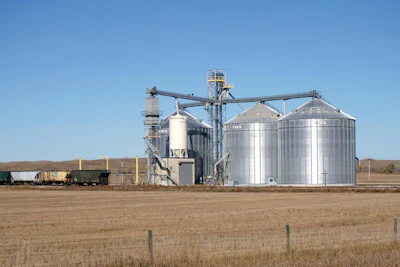
The U.S. Department of Agriculture’s Agricultural Marketing Service released its weekly Grain Transportation Report for the week ending August 22. The report tracks grain movement across rail, barge and ocean freight, along with fuel costs and export sales data. This week’s data shows mixed signals across transportation modes, with diesel prices continuing their sharp climb and barge traffic experiencing notable slowdowns.
Rail movements hold steady despite seasonal shifts
U.S. Class I railroads originated 26,543 grain carloads during the week ending August 15, a 1% decrease from the previous week. The numbers tell a more positive story when compared to historical data, that carloads were 4% higher than last year and 16% above the 3-year average.
Secondary railcar markets saw significant movement. Average September shuttle secondary railcar bids/offers jumped to $400 above tariff for the week ending August 20. This was $250 more than last week and $425 more than this week last year. Non-shuttle secondary railcar bids/offers averaged $28 above tariff, up $28 from last week and $16 more than this week last year.
Barge traffic slows on the river
Barged grain movements totaled 475,450 tons for the week, down 26% from the previous week and 2% less than the same week last year. The slowdown was evident in the number of barges moving down river with just 319 barges being moved during the week, 107 fewer than the previous week.
The New Orleans region unloaded 549 grain barges, 20% fewer than the previous week. The decline in barge movements could signal shifting harvest patterns or logistical adjustments as facilities manage grain flow.
Ocean freight shows year-over-year decline
Oceangoing grain vessels were loaded in the Gulf, 8% fewer than the same period last year. Looking ahead, 30 vessels were expected to be loaded within the next 10 days starting August, 21 and that's 39% fewer than last year.
Shipping rates remained relatively stable. The rate for shipping a metric ton of grain from the U.S. Gulf to Japan held at $73.00, unchanged from the previous week. The rate from the Pacific Northwest to Japan was $36.75 per mt, up 1% from the previous week.
Diesel prices surge
There's still more pain to be felt with diesel costs. The U.S. average diesel fuel price increased 19.8 cents from the previous week to $5.652/gallon. This puts diesel prices 194.4 cents above the same week last year. So that will continue to be significant cost factor for grain handlers and shipers.
Export sales show mixed results
Unshipped balances of corn and soybeans totaled 5.78 million metric tons, down 24% from last week but up 6% from the same time last year. The unshipped balance of wheat for marketing year 2026/27 was 3.84 mmt, down 1% from last week and down 41% from the same time last year.
Net corn export sales for marketing year 2025/26 were 0.031 mmt, down 87% from last week. Net soybean export sales were 0.074 mmt, down 13% from last week. Net wheat export sales for marketing year 2026/27 were 0.403 mmt, up 2% from last week.
The combination of rising diesel costs and shifting export patterns will require grain handlers to stay nimble in their logistics and storage planning as the industry moves into the corn and soybean harvest.