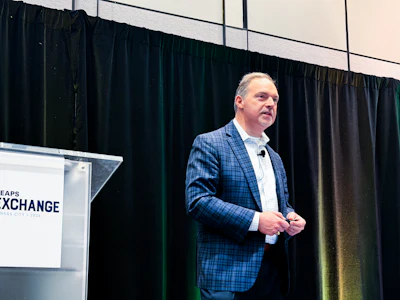
In a education session at the 2026 GEAPS Exchange, Jess McCluer, senior vice president of Safety and Regulatory at the National Grain and Feed Association (NGFA), provided a detailed update on federal OSHA’s current stance and outlook for the grain and feed industry. McCluer's presentation highlighted the challenges and opportunities facing the industry amid shifting enforcement priorities, staffing shortages and regulatory uncertainty.
Leadership and staffing challenges
McCluer opened by addressing the impact of federal workforce changes on OSHA’s capacity.
“Over 300,000 federal employees took early retirement recently,” McCluer explained, “which has had a significant impact on agency staffing, especially compliance safety and health officers.”
McCluer noted that as of late 2023, OSHA had about 730 inspectors nationwide, a number expected to decline further. This staffing shortage complicates enforcement but also shifts OSHA’s focus toward outreach and compliance assistance programs.
Shifting Enforcement Priorities
The current administration is emphasizing education and consultation over aggressive enforcement.
“There’s going to be a lot more focus on outreach, alliances and compliance assistance programs,” McCluer said.
McCluer encouraged industry professionals to build relationships with regional OSHA offices, as these connections can be valuable in navigating inspections and compliance.
Despite this outreach focus, the grain and feed industry remains a priority for OSHA inspections due to its higher-than-average incident rates. McCluer shared that in 2024, 70% of inspections in the industry resulted in citations, with 80% classified as serious or worse.
“It’s not a matter of if OSHA will come out, but when,” McCluer noted.
Key regulatory developments
McCluer discussed ongoing uncertainty around the proposed heat injury and illness rule. While some expected the new administration to rescind it, a public hearing held last year suggests they may instead revise and soften the rule rather than discard it entirely.
McCluer also touched on recent court decisions limiting OSHA’s jurisdiction over fall protection on rolling stock, a critical issue for grain facilities.
“The 8th Circuit ruled that OSHA does not have jurisdiction over work done around railcars — that’s the Federal Railway Administration’s domain,” McCluer explained.
OSHA is appealing the decision, and the industry is watching closely for guidance.
Practical takeaways
McCluer emphasized that OSHA standards represent the minimum requirements.
“Think of OSHA as the baseline,” McCluer said. “Facilities should consider going beyond to ensure safety and compliance.”
McCluer also highlighted the importance of accurate record-keeping, referencing a high-profile milling explosion case where poor training documentation led to criminal penalties.
For those managing grain and feed operations, McCluer recommended leveraging OSHA’s Safety Champions program to review and improve safety management plans.
“This fits well with the agency’s current focus on compliance assistance and outreach,” McCluer said.
Looking ahead
With federal budgets tightening and staffing constrained, the grain and feed industry must stay vigilant.
“There could be fewer funds for rulemaking or enforcement, so proactive safety management is more important than ever,” McCluer concluded.
Building strong relationships with OSHA and maintaining rigorous safety programs will be key to navigating the evolving regulatory landscape.