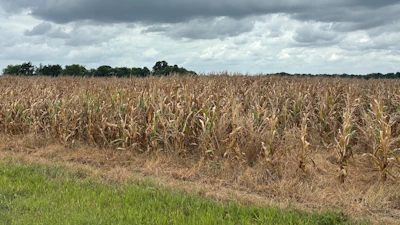
 Pest and disease issues have been minimal in Mississippi’s corn crop this year, but there has been an unusual amount of heat stress. This Noxubee County corn field was nearing harvest on July 23, 2026.MSU Extension Service | Josh Tilley
Erick Larson, corn specialist with the Mississippi State University Extension Service, said most of the crop will be mature by the end of the month. Most of Mississippi’s corn crop was planted in the last 10 days of March, and early planting combined with warmer-than-normal spring temperatures promoted earlier maturity.
Mississippi growers planted about 780,000 acres this year, down from a record 910,000 acres in 2025. Recent corn acreage has fluctuated widely, with 580,000 acres in 2022, 790,000 acres in 2023 and 490,000 acres in 2024.
Pest and disease issues have been minimal, but excessive rain beginning around Memorial Day and extending through June created problems. Larson said anaerobic soils, cloudy skies and high night temperatures limited the plant’s ability to produce energy, resulting in more kernel abortion in the tips of ears than normal.
This kernel abortion in the tips of corn ears, often called tip-back or tip dieback, is a condition where kernels at the very end of the cob cease developing and shrivel up. Kernels at the tip of the ear form last and receive fewer nutrients when the plant is stressed.
Tom Allen, Extension plant pathologist and researcher with the Mississippi Agricultural and Forestry Experiment Station, said fungus can invade areas where tip dieback has occurred.
“Not all of the fungi that invade the exposed tip are detrimental, but in some cases, some of the organisms that produce toxins such as Aspergillus can invade those aborted areas,” Allen said. “Some years, this can occur when it rains in parts of the state or fields that have had significant tip dieback.”
Allen urged growers who notice significant levels of tip dieback to seek assistance in determining which fungi may inhabit the ears if any fungal growth is observed on the exposed ear tips. Rainfall close to harvest can trigger fungal growth on exposed ear tips.
Josh Tilley, Extension agent in Noxubee County, said the crop in east Mississippi is headed to an early harvest the first week of August, if weather permits. The biggest challenge farmers in his area anticipate facing in the next month is the possibility that both corn and soybean fields will be ready to harvest at the same time.
“That could make harvest time a little tricky, but we will just have to see when the time comes,” Tilley said.
Tim Fondren, Extension agent in Leflore County, said high moisture harvest began the middle of July, and traditional moist corn harvest will begin in two to three weeks. Harvest in Leflore County should take six to seven weeks total.
Will Maples, Extension agricultural economist, said overall, corn producers are seeing a better market than last year. December corn futures prices peaked above $5 per bushel in mid-May. Through June, prices dropped back toward $4.40 due to favorable growing conditions in the Corn Belt, but prices have rallied back toward $4.70 per bushel as hot, dry weather has entered that region.
Nationally, corn acreage dropped to 95.3 million acres this year, and the U.S. Department of Agriculture is currently projecting production at 16 billion bushels. USDA’s August World Agricultural Supply and Demand Estimates will be the first to incorporate actual field surveys into its yield forecast, making the report especially important for corn marketing decisions.