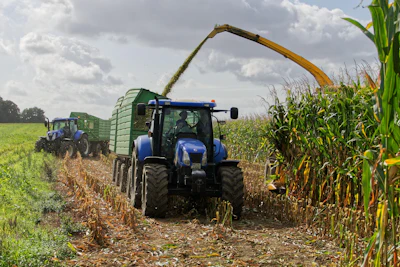
Corn harvest fell further behind its five-year pace, according to the weekly Crop Progress report released by the U.S. Department of Agriculture's National Agricultural Statistics Service (NASS), as wet fields in Iowa and the northern Plains slowed combines.
NASS estimated that 81% of the corn crop in 18 major states had been harvested through that date, up 7 percentage points from the prior week but 5 points behind the 2021-25 average of 86%. A week earlier, the gap was 3 points. Soybean harvest reached 92%, up from 88% and 1 point ahead of the 91% average.
Iowa is the main drag. The state's corn harvest stood at 72%, compared with an 89% average, and the gap widened from 13 points a week earlier. Iowa had 1.7 days suitable for fieldwork, the fewest of any state in the report, and 27% of its topsoil was rated surplus. Minnesota had 2.3 suitable days and South Dakota 2.7.
Other western Corn Belt states also trail. Nebraska was 74% harvested against an 84% average, South Dakota 68% against 85% and Minnesota 88% against 93%. Ohio sat at 69% against 75%. The eastern Corn Belt and northern edge are in better shape: Illinois reached 93% (91% average), Indiana 87% (82%) and North Dakota 85% (80%). Tennessee has finished.
That shifts the timing of fall grain movement. For elevators, ethanol plants and feed mills that source from Iowa, Nebraska and the Dakotas, a later finish stretches harvest receiving deeper into November, keeping drying, storage and shipping decisions open longer than in a typical year.
Sorghum is further off pace. Harvest reached 70% across six states, 15 points behind the 85% average, with Kansas at 57% (80% average) and Nebraska at 54% (79%). Soybean harvest is nearly wrapped up, though Kansas trailed at 78% against an 86% average. Louisiana, Minnesota and Mississippi have finished soybeans.
The 2027 winter wheat crop is close to normal. Planting reached 89%, 1 point behind average, and 76% of the crop had emerged, ahead of the 74% average. NASS rated 49% of the crop good to excellent, up from 44% a week earlier, while 16% was rated poor to very poor, down from 18%. Oklahoma lagged at 77% planted against an 86% average, with 36% of its wheat rated good to excellent. Texas rated 25% of its wheat poor to very poor.
Dryness eased slightly. Nationally, 34% of topsoil was rated short to very short, down from 38% the prior week. The Delta remains dry, with 84% of Arkansas and 87% of Louisiana topsoil rated short to very short.
The report carries no year-ago comparisons. A lapse in federal funding in October and November 2025 canceled Crop Progress reports for the weeks ending Oct. 5 through Nov. 9, 2025, so the five-year average uses imputed 2025 estimates. NASS said the latest figures are subject to revision. The next report, covering corn, soybean, sorghum and winter wheat progress, is due Nov. 16.