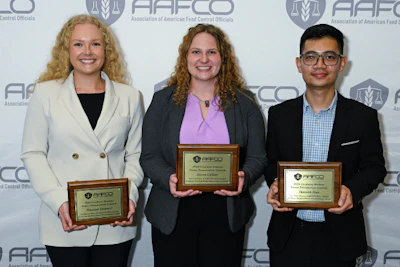

Sierra Collier of Kansas State University took first place for her research on soybean meal composition and variability across U.S. processing plants. Collier recently completed her master’s degree in Applied Swine Nutrition and examined how trypsin inhibitors affect nursery pig growth. She will begin doctoral studies at Kansas State this fall.
Hannah Shinnerl from the University of Illinois Urbana-Champaign earned second place for developing an analytical method to measure chitin in insect-sourced materials. Shinnerl recently finished her master’s degree in Animal Sciences and is now pursuing a Ph.D., focusing on methods that support innovation in animal nutrition.
Third place went to Vannith Hay, a doctoral student in Food Science and Technology at the University of Nebraska-Lincoln. His research examines using non-pathogenic bacteria as surrogates for Salmonella in high-pressure processing studies of raw poultry-based pet foods.
Nine finalists displayed posters at the meeting after submitting research abstracts on challenges facing regulators and the animal food industry. AAFCO members and Kansas State University Olathe faculty reviewed entries based on research relevance, quality and practical value.
“The Graduate Student Poster session has been a successful addition to our annual meeting,” said Austin Therrell, executive director of AAFCO. “It’s been inspiring to see the students’ vision regarding the future of animal food and to see them engage with major players across the animal food industry, regulators and academics.”