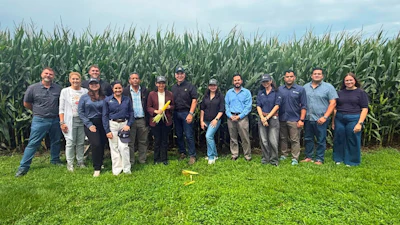
The U.S. Grains & BioProducts Council hosted senior Panamanian government and maritime sector leaders earlier this month to examine how U.S. bioethanol can work as a feedstock for sustainable marine fuel.
The delegation visited facilities in Illinois and Texas to learn about ethanol production, export logistics and its role in reducing carbon emissions from shipping.
“Panama holds a strategic role in global shipping as steward of the Panama Canal and as a host of one of the world’s largest ship registries,” said Federico Salcedo, USGBC Latin America regional ethanol strategy lead. “As the maritime sector advances toward its decarbonization goals under the International Maritime Organization’s greenhouse gas strategy, Panama is well positioned to evaluate technically and commercially viable low-carbon marine fuel options.”
The group started in Chicago, visiting the University of Illinois-Chicago’s Energy Resources Center and Argonne National Laboratory to discuss the U.S. ethanol industry and current biofuels research. They toured Marquis Energy’s ethanol plant in Hennepin to see production and carbon capture techniques, then visited a farm in Toulon to observe climate-smart agricultural practices.
In Houston, the delegation toured Advario and Eco-Energy’s liquid bulk storage facilities and export terminal. They also met with Everlence to see engines ready for large-scale sustainable marine fuel adoption and with the American Bureau of Shipping to learn about safety regulations and bunkering standards.
“Bioethanol offers a readily available, scalable pathway to lower the carbon intensity of marine fuels,” Salcedo said.