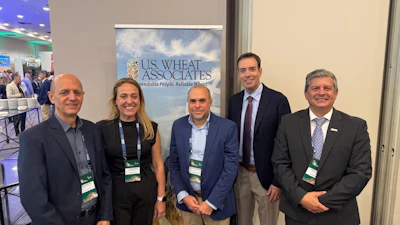

More than 600 flour millers, bakers, government officials and industry suppliers attended the congress, held Oct. 21-23 at the Windsor Barra Hotel by the Brazilian Wheat Industry Association (Abitrigo), according to a USW Wheat Letter report published Nov. 5. USW President and CEO Mike Spier attended with Miguel Galdos, USW regional director for South America; Claudia Gomez, USW regional marketing manager; and Oscar Garavaglia, a USW consultant in Brazil.uswheat+2
The supply backdrop favors imports. The Foreign Agricultural Service of the U.S. Department of Agriculture forecast Brazil's 2026-27 wheat crop down 22.5% to 6.1 million metric tons in its August Grain and Feed Update. The report cited reduced planted area, lower investment and rising input costs made worse by recent crop failures and price volatility, and said the smaller crop would drive Brazil's import demand to a record high.
Spier said the meetings came as Brazil is expected to need substantial high-quality wheat to blend with lower-quality supplies from its own harvest and from Argentina.
"Our team has strong relationships with Brazilian buyers and Oscar is working with Brazilian mills every day. We shared U.S. wheat crop quality data and how U.S. wheat fits blending needs this year," Spier said.
The pitch rests on blend economics. Millers have raised quality concerns about new-crop Brazilian and Argentine wheat, and flour improvers can cost up to $40 per metric ton, according to USW. The team told millers that U.S. hard red winter wheat and other classes can improve a blend when local or regional wheat varies in protein, milling performance or baking functionality.
"The opportunity is not necessarily to replace local or regional wheat, but to demonstrate how U.S. wheat can complement it and help millers achieve more consistent flour quality and end-use performance," Gomez said.
Gomez said the economics should account for flour consistency, milling and baking performance and the potential cost of corrective ingredients such as flour improvers, not just the price per ton of wheat.
The congress also gave the USW team access to milling executives, traders, government representatives and the new leadership of the Brazilian Association of Bakery and Confectionery Industries (ABIP). Spier described Brazil as a highly competitive and price-sensitive market for U.S. wheat farmers. USW did not report any purchase commitments from the meetings.