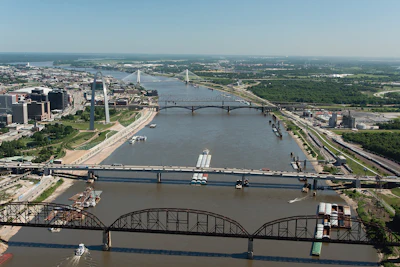
St. Louis isn't the biggest inland port by raw tonnage. By the measure that matters most to shippers and carriers, tons moved per river mile, nothing in the country comes close.
 St. Louis Regional Freightway
In 2024, the St. Louis Metro Port handled 24.8 million tons of cargo and moved 354,286 tons per river mile, more than twice the per-mile volume of each of the three port districts that handled more total tonnage. The system also moved more than 10 times the 31,072-ton-per-mile average posted by the other three inland districts in the data set.
That throughput comes from a cluster of port authorities operating across two states. The St. Louis Metro Ports, as defined by the Corps, include America's Central Port and the Southwest Regional Port District in Illinois, along with the St. Louis City Port Authority, St. Louis County Port Authority and Jefferson County Port Authority in Missouri. The Kaskaskia Regional Port District sits outside the Corps' definition but remains a significant bi-state player, consistently handling more than 5 million tons of cargo annually since 2017.
A 500-mile radius around the St. Louis region produces 50% of U.S. crops and livestock, including roughly 80% of U.S. corn and soybean acreage. That production base feeds into a 15-mile stretch of the Mississippi known as the Ag Coast of America, where 16 barge-transfer facilities can collectively handle more than 150 barges per day at full capacity.
Holding that edge takes money and planning. Mary Lamie of Bi-State Development and the St. Louis Regional Freightway said port efficiency translates into real value for shippers and carriers, crediting investments in infrastructure, equipment and multimodal connections. The organization works to optimize the region's freight network, strengthen modal flexibility and raise awareness of the area's global connectivity.
America's Central Port offers the clearest example of the current build-out. The port recently added an 80,000-bushel grain bin at Madison Harbor and upgraded rail, roads, warehouses and dock facilities. Its 2025 master plan identifies 60 waterside and landside projects, with four completed and 10 in planning or design. A truck staging and calling lot is under construction to reduce roadway and terminal congestion, and a $5 million expansion of the Granite City General Cargo Dock is expected to begin soon. Two sizeable tenant expansions are also expected to be announced in the coming months, though the port has not yet identified the tenants or project details.
The Missouri side is pressing on congestion and cargo capacity from several directions. The St. Louis City Port Authority manages about 45 leases with shippers and carriers along the city's 19-mile riverfront and owns the Municipal River Terminal, where SCF Terminals continues to upgrade rail capabilities. The authority is also preparing an 11.6-acre south riverfront site for future multimodal development, with Union Pacific rail service and direct access to Interstate 55. Downriver, the Jefferson County Port Authority reports that a new material handler has cut loading time by more than half, with a $186,000 state grant helping fund another loader. The authority is building a new port entrance road and participating in a container-on-vessel feasibility study.
The region's accounting gets more complicated on the Illinois side. The Southwest Regional Port District moved 7.3 million tons of commodities through the St. Louis Port system in 2024 and, according to the Freightway, was integrated into the Kaskaskia Regional Port District in January 2026. Kaskaskia itself handled 6.4 million tons in 2024, but that tonnage sits outside the Corps' St. Louis Metro Port definition and is not counted in the 24.8-million-ton total. Kaskaskia is investing on its own track, with a $10 million rail improvement project at KRPD #1 in New Athens, Illinois, and a combined federal and state investment of nearly $16.25 million in the KRPD #2 South Dock project in Red Bud, Illinois.