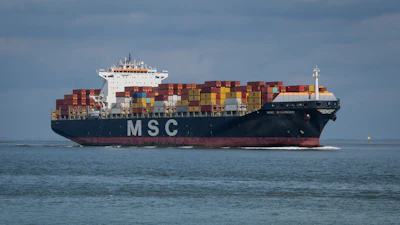
U.S. exports of distillers dried grains with solubles, or DDGS, rose 13% through August from the same period last year, with container shipping taking a larger share of the trade, according to the USDA Agricultural Marketing Service.
The feature article in the agency's Oct. 29 Grain Transportation Report found that waterborne containerized DDGS exports were up 42% from the same period in 2025, while waterborne bulk DDGS exports fell 14%. From January to August, the container share of waterborne DDGS exports climbed from 40% in 2022 to 64% in 2026.
DDGS accounted for 8% of total U.S. grain export volumes through August and 34% of containerized grain export volumes, according to the report.
Why containers are winning
The shift comes down to buyer preference, the report said. Asian buyers tend to order smaller, more frequent shipments sized for local feed mills rather than full vessel loads, and containers let U.S. exporters meet that demand with consistent quality and packaging.
Freight costs also moved in containers' favor. From January to August, the rate for a 40-foot container from the U.S. West Coast to Shanghai averaged $922, up 13% from a year earlier. Bulk grain freight from the Pacific Northwest to Japan averaged $34.19 per metric ton, up 25%, as grain competed with iron ore and coal for vessel space and bunker fuel costs rose.
That does not make containers trouble-free. Container shippers faced port congestion, equipment shortages and inland bottlenecks, while bulk shipping remained cheaper per ton for large volumes, the report said.
Exports up as production slips
Export growth came even as DDGS output declined. Production through August was down 2% from a year earlier, even as ethanol production rose. The report tied that to more efficient dry mills that produce more ethanol and corn oil per bushel, with the DDGS yield falling from 16.95 pounds per bushel in 2014 to 15.18 pounds in 2025.
Mexico, Indonesia, South Korea, Vietnam, Colombia and Turkey took 67% of U.S. DDGS exports through August. Indonesia's purchases more than doubled, up 101%, driven by livestock and poultry demand, tighter domestic supplies and commitments under the U.S.-Indonesia Reciprocal Trade Agreement. Indonesia also passed Vietnam as the top buyer of containerized U.S. DDGS.
New Orleans handled 24% of DDGS export volumes, followed by Los Angeles at 18%, Laredo, Texas, at 10%, New York at 7% and El Paso, Texas, at 6%.
Oat rates and port fees
The report also tracked rate increases for Canadian oats moving south. Effective Sunday, BNSF Railway will raise its oat tariffs by $200 per car. Canadian Pacific Kansas City raised per-car rates in October by $210 from Canada to Minneapolis and $215 to Duluth, Minnesota, and Chicago. Canadian National Railway raised its rates in September by $225 per car to Cedar Rapids and St. Ansgar, Iowa.
On the ocean side, the Office of the U.S. Trade Representative has proposed extending its suspension of Section 301 port fees on China-linked vessels through Jan. 9, 2027. Comments are due by 5 p.m. Friday. If reinstated, the fees would charge Chinese-owned or -operated vessels $50 per net ton and Chinese-built vessels $18 per net ton or $120 per container, the report said.
Weekly indicators
Class I railroads originated 29,072 grain carloads during the week ended Oct. 17, up 9% from a year earlier. Barged grain movements totaled 535,600 tons for the week ended Oct. 24, down 25% from the same week last year. The U.S. average diesel price rose 7.6 cents to $6.352 per gallon for the week ended Oct. 26, up $2.634 from a year earlier.