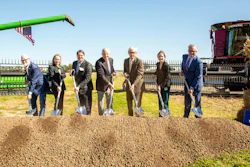
 IL Corn Exec Director Rodney Weinzierl makes comments about farmer investment in NCERC.Illinois Corn Marketing Board
The investment includes $15 million from the State of Illinois and $2 million from the Illinois Corn Growers Association. The expansion comes as Illinois farmers face rising costs from federal policies and uncertainty in agricultural markets.
“As federal policies drive up costs for farmers and consumers, we’re working to provide relief while providing new investments for Illinois farmers to grow,” Pritzker said. “This expansion will help turn Illinois crops into new products and create more opportunities and good-paying jobs in Southwestern Illinois.”
Building the bioeconomy
The funding will allow NCERC to build additional research space and serve more companies developing and commercializing new bioproducts. The center has spent more than two decades partnering with startups and technology developers to bring innovations to market, contributing to the advancement of more than 100 technologies toward commercial readiness, especially in corn-to-ethanol production.
Rodney Weinzierl, executive director for the Illinois Corn Marketing Board, said the expansion represents an opportunity to build a bioeconomy where U.S. corn-based products replace petroleum-based products.
“This NCERC expansion will result in more space, more fermentation tanks, and more expertise to guide new ideas to commercialization,” Weinzierl said. “For the last 23 years, NCERC has helped scale countless technologies that make ethanol production more efficient, doing the research that allows for more ethanol production per bushel of corn.”
SIUE Chancellor James T. Minor said the expansion creates opportunities for innovation beyond traditional ethanol. The center will work on developing technologies for sustainable aviation fuel, biodiesel and cellulosic ethanol products.
“As NCERC established itself as a leading proof-of-concept partner, we knew that it could do much more,” Minor said. “This expansion unlocks the potential of renewable feedstocks, the acceleration of industry research, and the ability to develop technologies that tomorrow’s bioeconomy will require.”
Filling a competitive gap
The expansion addresses a national shortage in fermentation capacity for developing and testing new products at commercial scales. The U.S. currently has limited capacity, leading some American companies to develop and test products at facilities outside the country.
Europe has about twice the precision fermentation capacity of the U.S., while China accounts for about 70% of the world’s basic fermentation capacity. The NCERC expansion will add fermentation capacity in the U.S. for companies developing and testing new bioproducts.
The Illinois General Assembly designated NCERC as a Biorefining Center of Excellence. The center can scale fermentation processes to 22,000 liters, the largest process development capacity provided by an academic institution in the United States. The center’s business model is similar to a contract research organization and allows for a range of technology testing and product development.
What the expansion includes
The expanded facility will feature explosion-proof, Biosafety Level 2 work areas, two 5,000-liter bioreactors, processing and purification capabilities, and intake, distribution and maintenance space. The additions will allow NCERC to connect with the biomanufacturing industry for biorenewables production and validate both in-house and external high-impact processes through scalability and demonstration toward commercialization.
NCERC Executive Director Praveen Vadlani said the expansion represents a strategic investment in Illinois’ long-term competitiveness. The center will integrate advanced capabilities in agricultural feedstock utilization, AI, automation and digital bioprocessing with hands-on workforce development.
“NCERC will accelerate the commercialization of innovative technologies, attract private-sector investment, and prepare the skilled talent needed to advance the next generation of biomanufacturing,” Vadlani said.
Relief for struggling farmers
Agriculture is the backbone of the Illinois economy and is currently experiencing a significant economic downturn. As the second-largest corn-producing state, investment in the use of corn and corn co-products will boost the entire Illinois economy, officials said.
“Today’s ag economy is poor, and many family farmers are struggling to keep their farms viable with razor thin margins,” Weinzierl said. “Illinois corn farmers need markets. While an NCERC expansion will not deliver immediate corn market growth, it will provide opportunities for future generations of corn farmers and will help to bring young people to our rural communities.”
Mark Bunselmeyer, Illinois Corn Growers Association president and a farmer from Maroa, said the investment demonstrates a commitment to building technologies and opportunities that will shape the future of Illinois agriculture.
“With this investment in added scale-up capacity, we can continue improving ethanol efficiency while creating new bio-based products and building markets for the next generation of farmers,” Bunselmeyer said.
Workforce development focus
The expansion will support workforce development through partnerships with SIUE and Lewis and Clark Community College. Officials expect the expanded facilities to train an additional 200 workers each year through various workforce development programs, building a pipeline of skilled workers for Illinois’ growing biomanufacturing and advanced manufacturing sectors.
The project is expected to create about 25 new full-time positions at NCERC and support more than 100 construction jobs for local trades during the expansion. The expansion will also create greater opportunities to train the next generation of researchers through partnership with SIUE.
“This announcement will usher in a new era for SIUE, for student researchers, for our corn growers, and for the future of the bioeconomy here in Illinois,” said Rep. Nikki Budzinski, who serves as co-chair of the Biofuels Congress. She said she submitted an additional federal funding request this year to boost the investment.
Timing amid fuel cost concerns
The announcement comes during a period when Illinoisans are looking for more affordable fuel options. Gasoline costs have risen due to the Trump Administration’s conflict with Iran and economic policies. Earlier this week, Pritzker issued a state disaster proclamation and signed an executive order to provide relief on diesel costs. He has also called on Congressional leaders to pass legislation permanently allowing year-round sales of E15 gasoline.
Kyle Anderson, executive director of the Leadership Council Southwestern Illinois, said NCERC’s ability to take emerging technologies from research and development through scale-up and toward commercialization gives companies a reason to consider the region when deciding where to innovate and invest.
“This expansion will strengthen NCERC’s position as a national and international destination for companies working in biofuels and other areas of the growing bioeconomy,” Anderson said.
The project will strengthen the regional economy and support the continued growth of University Park at SIUE, officials said.