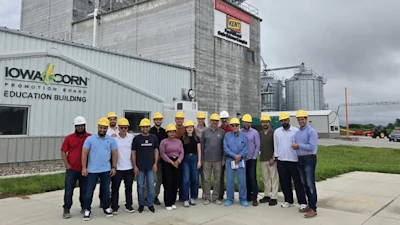
The U.S. Grains & BioProducts Council brought 10 feed milling professionals from Colombia, Saudi Arabia, New Zealand and Panama to Iowa State University last week for hands-on training in feed manufacturing and mill management practices.
The week-long program focused on helping participants improve operational efficiencies and storage methods that make the most of U.S. corn and co-products’ nutritional value.
“The Council works around the world with our customers to demonstrate U.S. corn and co-products’ superior advantages, as well as identifying and helping overcome challenges such as on-site storage and improving processing operations,” said Mark Sevier, USGBC manager of global strategies and trade.
Participants face serious obstacles in their home countries, including hot and humid climates that threaten grain quality, limited training opportunities and inadequate equipment investment.
The program combined classroom instruction with practical training at ISU’s Kent Feed Mill & Grain Science Complex. Attendees learned hammer and roller milling techniques, particle size analysis, batching and mixing, steam generation and conditioning, pelleting, cooling and post-pelleting applications.
They also received hands-on experience with mixer uniformity, pelleting and pellet durability testing, plus instruction on maintaining the quality of stored grains, distiller’s dried grains with solubles and other ingredients.
The group toured a POET ethanol plant in Iowa Falls to observe DDGS production and visited a local farm to see corn crops firsthand.
“Some of the companies invited to this program have already participated in commercial trials demonstrating and maximizing the value of U.S. corn, providing sustained outreach to important regional customers,” Sevier said.
He noted that U.S. farmers set the standard for corn quality, and maintaining that quality during transit and storage remains a priority for international end-users working with the Council to improve U.S. corn’s global competitiveness.