The U.S. inland waterways system — a critical artery for American agricultural exports — is under compounding pressure from workforce losses, chronic underfunding and cost overruns on billion-dollar infrastructure projects, according to Jennifer Armstrong, vice president of government affairs for the Waterways Council, Inc. (WCI). With more than 60% of U.S. grain exports traveling the inland waterway network, the stakes extend well beyond infrastructure policy.
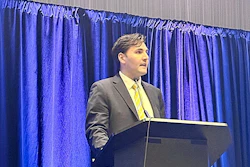
Armstrong, a leading advocate for inland waterways, spoke at the National Grain and Feed Association's (NGFA) 130th Annual Convention on March 22 in Nashville about the challenges facing the system and what the industry can do to help move the needle in Washington.
"It's very important to educate and communicate with Congress and other stakeholders on what we do," Armstrong said.
Workforce crisis
Among the most urgent concerns raised was a dramatic loss of experienced personnel at the U.S. Army Corps of Engineers, which operates and maintains the nation's locks and dams. Recent federal retirements have cost the agency approximately 5,500 employees. Jennifer Armstrong, vice president of government affairs, Waterways Council, Inc.
"Those 5,500 employees represented 90,000 years of experience in the engineering civil workspace," Armstrong said. "So not only did you have a loss over time, but now you have this one-time exponential just loss that's pretty significant."
The losses compound an already difficult hiring environment. Because many lock operator positions are located in rural areas far from major population centers, filling vacancies through the federal hiring process is a slow and uncertain proposition.
WCI is actively monitoring staffing gaps and communicating needs directly to the Corps to ensure exemptions to the current federal hiring freeze are extended where necessary.
Funding uncertainty drives up costs
Beyond staffing, Armstrong pointed to structural funding problems that make large-scale construction projects more expensive and slower to complete. Annual, project-by-project appropriations — rather than multi-year funding commitments — force contractors to price uncertainty into their bids.
"The worst thing that you can do when you're trying to construct a large multi-billion dollar project is to have annual project by project appropriations with no certainty of future funding," Armstrong said. "Because contractors are going to build that risk into their bids, and it makes inherently a cost more."
Over the last decade, WCI has worked to close that gap by advocating directly with Congress to fund projects the president's budget consistently overlooks, securing more than $6 billion above presidential budget requests in that period.
Trust fund stretched too thin
A key legislative priority for WCI this year is addressing what Armstrong described as an inequitable cost-sharing arrangement. Commercial waterway users pay a 29-cent-per-gallon fuel tax into the Inland Waterway Trust Fund, which helps finance major modernization and rehabilitation projects. But that fund is increasingly being tapped for dam repairs that benefit a much broader set of users, including hydropower generators, municipalities, irrigators, and recreational boaters — who contribute nothing to it.
"We are the only beneficiary of the system that pays into that rehabilitation," Armstrong said. "And so we're going to be strained to be able to meet the needs of the ongoing work that we have, the modernization that's critical, if we're also funding the dam repairs that are really benefiting more of those other beneficiaries."
WCI is pushing Congress to establish parity between the dam safety program and the rest of the Corps' portfolio, where life-safety risks are treated as a federal responsibility regardless of whether a navigation lock is attached.
WRDA outlook: Cautious optimism
Armstrong expressed measured optimism that the Water Resources Development Act (WRDA) — the biennial legislation that authorizes Corps of Engineers projects and sets waterway infrastructure policy — will advance on schedule this year. Committee requests were collected in January and February, with markup expected in the House Transportation and Infrastructure Committee and the Senate Environment and Public Works Committee by summer. Final passage, as has been the pattern, would likely come at year's end attached to must-pass legislation. Several factors point in WRDA's favor.
Speaker Mike Johnson has publicly named it as one of his priorities for this Congress, alongside the Farm Bill and surface transportation reauthorization. Armstrong also noted encouraging signs of bipartisanship on the House T&I Committee, where Chairman Gray is actively working across the aisle.
"There aren't a lot of opportunities for congressional members to be able to take that back, especially in an election year, to go back to the constituents and say, I got this win for my district," Armstrong said.
She stopped short of a firm prediction, expressing hope rather than certainty that bipartisanship would carry the bill across the finish line. With the $687 million funding request riding on the outcome, including a critical $250 million needed to keep Lock and Dam 25 on track for contract award in fiscal year 2027, the stakes of getting WRDA done on time have rarely been higher.
What the industry can do
Armstrong's plea to NGFA members was to show up and tell your story. Face-to-face conversations with congressional offices — both in Washington and at the district level — are among the most effective tools available to industry stakeholders, particularly as experienced legislators retire and new members need to be educated on the complexity of waterways policy.
"If the Corps doesn't start improving or reforming how they execute these projects, it's going to be harder and harder for us to convince these members to put their neck out there," Armstrong said.
Allison Rivera, vice president of government and legislative affairs, NGFA, reinforced the point. "Talk about how important the waterways are to businesses, to the export markets, to everything that you do every day, and how it gives us the upper hand to other countries."
Armstrong said WCI's website offers state-by-state commodity traffic profiles and data that are "huge storytelling tools" for members heading into those conversations.
With WRDA legislation expected to move through committee this summer and a fiscal year 2027 funding request of $687 million on the line, Armstrong said the window for meaningful engagement is now.