With grain bin entrapment incidents already tracking above historic highs just two months into the year, safety experts at GEAPS Exchange 2026 delivered an urgent hands-on message: proper entry protocols and rescue preparedness aren't optional — they're the difference between a rescue and a recovery.
Dan Neenan of the National Education Center for Agricultural Safety and Dr. Carol Jones, retired from Oklahoma State University and principal of CL Jones Consulting, led a live grain bin rescue demonstration that walked attendees through everything from pre-entry lockout/tagout procedures to the physics of grain entrapment and the mechanics of a coordinated rescue.
A troubling trend
Jones opened with a sobering data point. By the time GEAPS Exchange convened in February, the industry had already recorded 11 to 13 grain bin entrapment incidents — a pace that, if sustained, would eclipse the deadliest year on record.
"The 2010 corn crop was bad," Jones said. "We had twice as many entrapments and deaths that year than any other year. So far this year, we've had 11 or 13, and it's just February."
Jones attributed the trend in part to prolonged grain storage driven by market, weather and transportation volatility.
"Anytime the grain goes out of condition, we have a safety problem,” Joes said. “The two are just directly correlated."
The root cause, she emphasized, is that grain that enters storage in poor condition is more likely to bridge, crust and create the unstable conditions that pull workers in.
"If the grain goes in the bin in good condition and we do a good job of managing it with aeration and monitoring, it comes out in good condition,” said Jones. “That's when we don't have to go in the bin, because everything works right."
Before anyone steps inside
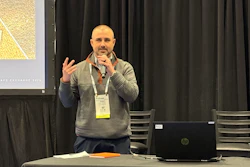
 Dan Neenan of the National Education Center for Agricultural Safety. Elise Schafer
Lockout/tagout. Neenan demonstrated the procedure live, completing it in under 10 seconds. He noted that a basic lockout/tagout kit starts at $35 and that standing to the side — never in front — of an electrical panel when shutting it off is critical to avoiding arc flash. "Is your life worth $35?" he asked.
The stakes are immediate: without lockout/tagout in place, an activated sweep auger can sink a person to the waist in 15 seconds and completely submerge them within 30.
Air quality monitoring. Jones and Neenan cited an Iowa incident in which a father and son were killed in a grain bin — not by entrapment, but by oxygen deprivation. A smoldering fire had consumed the bin's oxygen and produced carbon monoxide levels of 500 parts per million the day after the fatalities.
A standard residential CO detector alarms at 35 ppm. Oxygen levels below 19.5% cannot support life, and concentrations in the 17-18% range trigger hand-eye coordination failure and convulsions.
"That fire chief in Oklahoma didn't have to die," Jones said, referencing the incident that launched OSU's grain safety education program. "They went in to try to put out a fire they weren't going to be able to put out anyway, and he died of oxygen deprivation because they weren't monitoring the air."
Confined space permits and minimum crew size. Neenan stressed that bin entry is legally classified as confined space work and requires a completed permit before entry. He also called the two-person minimum — one worker inside, one dedicated attendant outside — the most frequently violated rule in agricultural grain handling. The attendant's sole job is to monitor the entrant and call 911 if anything goes wrong.
"If she becomes unresponsive and I go in to help and I become unresponsive — am I helping her?” Neenan said. “Am I helping me? No."
Body harnesses. All workers entering a bin must wear a full-body harness, properly fitted high and tight, with keys and phones removed from pockets to avoid pressure injuries if the harness bears weight.
When a rescue Is required
Once a worker is entrapped, conventional instincts become dangerous. Struggling accelerates sinking. Attempting to physically pull someone free can cause severe injury — extracting a 165-pound person buried to the waist requires approximately 325 pounds of upward force; pulling someone buried to the neck risks dislocating or tearing limbs.
The grain rescue tube has transformed survival odds. Since the Grain Bin Safety Week contest launched in 2014, more than 452 tubes have been distributed across 35 states through the program, and 16 have been used in actual rescues — including one just south of Kansas City in Jasper, Missouri, weeks before the conference.
The rescue process Neenan and Jones demonstrated involves assembling a multi-panel coffer dam around the victim, sinking it down using rescuers' body weight, then deploying a grain auger inside the tube to remove approximately 2.5 bushels of grain per minute.
Panels are built from back to front so the victim maintains a sightline outward — a detail Jones called critical to managing panic.
"Their pulse rate may already be up to 200,” Jones said. “We've got to manage their mind as well as their body."
The forces involved are substantial. Driving a panel two feet into grain requires 200 to 250 pounds of force; the third foot demands 700 pounds. Teams must rotate rescuers every 15 minutes to manage fatigue. A successful rescue — not a recovery — typically requires the equivalent of 125 people across multiple departments.
"How many volunteer fire departments have 125 people?" Jones asked. "This is going to take a lot of communication between neighboring departments on equipment and personnel."
After the rescue: Compartment syndrome
Neenan closed with a warning that many facility managers overlook entirely: a rescued worker who appears fine may still be in serious danger.
Crush compartment syndrome — caused by sustained pressure on the lower body — produces symptoms that may not appear until 20 minutes to an hour after the pressure is released. Treatment requires a trauma surgeon, not a local rural emergency room.
If the affected muscle in the lower leg ruptures without intervention, the victim may never walk normally again.
"If you're a company, you might want to consider making it mandatory that the person go get checked out after such an incident," Neenan said.
Call to action
Both presenters urged facility managers to invite local fire departments to their sites before an emergency occurs. With 95% of grain bin incidents responded to by volunteer departments — many of whose personnel have no agricultural background — familiarity with the environment can be lifesaving.
From January 1 through April 30, facilities can nominate their local fire department to receive a free rescue tube and training at grainbinsafetyweek.com.
"We're starting to turn the tide," Neenan said. "Being entrapped in a bin is still not something you aim for — but it can be survivable."