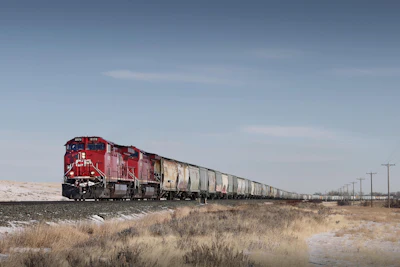
Canadian Pacific Kansas City plans to transport up to 34.5 million metric tonnes of Canadian grain in 2026-27, supported by over $500 million in high-capacity hopper car investments and new Tier 4 locomotives that increase volume capacity by 44 percent per train unit.
- CPKC targets 34.5 million metric tonnes of grain transport for the 2026-27 crop year
- New high-capacity hopper cars deliver 44% more volume per grain unit train when combined with CPKC's 8,500-foot High Efficiency Product train model
- CPKC recorded the lowest train accident frequency among Class 1 railways for the third consecutive year in 2025, 65% lower than industry average
- The company invested over $500 million in 5,900 Canadian-made hopper cars and is receiving 65 new Tier 4 locomotives as part of a multi-year $1 billion locomotive program
- Capacity will range from 540,000 to 700,000 metric tonnes weekly depending on seasonal port operations
Canadian Pacific Kansas City released its 2026-2027 Grain Service Outlook Report on July 31, outlining plans to transport up to 34.5 million metric tonnes of Canadian grain and grain products during the upcoming crop year. The railway is on track to conclude the 2025-2026 crop year having moved more than 30 million metric tonnes despite weather challenges and demand fluctuations.
CPKC transported 28.9 million metric tonnes through Week 49 of the current crop year, representing a 9 percent increase over the previous year, 15 percent above the three-year average, and 19 percent higher than the five-year average.
Capacity targets adjusted for seasonal patterns
The railway plans to supply capacity for up to 700,000 metric tonnes of grain weekly during Grain Service Weeks 1-23 (August 2 to January 9) and Weeks 35-52 (March 28 to July 31), when the Port of Thunder Bay operates. During winter months when Thunder Bay closes, CPKC will provide capacity for up to 540,000 metric tonnes weekly through Weeks 24-34 (January 10 to March 27).
Agriculture and Agri-Food Canada projected a Canada-wide crop of 96 million metric tonnes for 2026-2027 on June 19. This translates to approximately 74.5 million metric tonnes for Western Canada, a 12 percent decline from the 2025-2026 record crop of 85 million metric tonnes but in line with the four-year average.
Safety performance leads industry
For the third consecutive year, CPKC recorded the lowest Federal Railroad Administration reportable train accident frequency among Class 1 railways in 2025. The company’s train accident frequency was 65 percent lower than the Class 1 industry average. CPKC matched its best year for personal injury performance in 2025, showing a 46 percent improvement since 2013.
Equipment investments expand capacity
CPKC invested more than $500 million in 5,900 Canadian-made, high-capacity grain hopper cars in recent years. The railway is leasing hundreds of additional high-capacity hopper cars starting in August 2026. Approximately 90 percent of CPKC’s expanded grain hopper fleet is now high capacity.
The company accepted delivery of its 170th and final Wabtec Tier 4 locomotive in June 2026, completing a purchase of 100 new units in 2025. Progress Rail is expected to deliver the first of 65 new Tier 4 units later this year as part of a multi-year program involving more than $1 billion in new locomotive power.
CPKC’s new high-capacity hopper cars are 5 percent shorter than government hoppers at 56 feet versus 59 feet, allowing more cars per train. The cars handle 15 percent greater volume and 10 percent greater load weight than traditional cars. When combined with CPKC’s 8,500-foot High Efficiency Product train model, the new hopper cars deliver more than 44 percent more volume capacity in each grain unit train.
Weather and operational challenges
The 2025-2026 crop year faced an early start to winter, requiring 50 days with safety-related train length and speed restrictions. Weeks of inclement weather in Vancouver affected grain loading by terminals to vessels at the port.
CPKC spent a record $3.1 billion in capital in 2025 to improve safety and increase network capacity, resiliency, and efficiency. The company plans approximately $2.65 billion in capital investments for 2026, with guidance targeting $2.6 billion to $2.8 billion annually for 2027-2028.