The U.S. Department of Agriculture’s latest Grain Transportation Report shows only minor changes to corn rail tariff rates for marketing year 2026/27, reflecting expectations for continued strong rail demand despite a projected smaller corn crop. After last year’s record corn harvest and export activity pushed rail grain carloads to multi-decade highs, railroads are making small rate adjustments as farmers prepare to harvest the second-largest corn crop on record.
Record corn harvest drives rail grain shipments in 2025/26
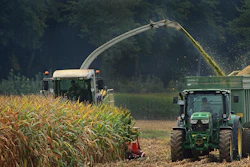
In marketing year 2025/26, U.S. farmers produced a record 17 billion bushels of corn, 17% above the prior five-year average and 1.7 billion bushels more than the previous record set in 2023. The largest increases came from western Corn Belt states such as South Dakota, Nebraska, and North Dakota, where production rose by more than 250 million bushels each.
This record crop supported strong demand for corn both domestically and internationally. USDA projects total domestic use at 13.3 billion bushels, an 8% increase from average and an all-time high if realized. Within domestic use, food, alcohol, and industrial uses are estimated at 6.9 billion bushels, up 3% from average, while feed and residual use is projected at 6.4 billion bushels, up 13%.
Exports were the biggest driver of demand growth. From September 2025 to July 2026, U.S. corn exports totaled 3.1 billion bushels, 40% above the five-year average. Significant export gains occurred through ports like the Pacific Northwest, which saw a 104% increase, and Norfolk, Virginia, which surged 468%. The rise in Pacific Northwest exports was linked to the large corn supplies in the western Corn Belt and reduced soybean exports freeing up export capacity.
Railroads responded with small tariff rate adjustments. BNSF Railway held rates steady to Pacific Northwest export terminals but cut rates to feedlots in Hereford, Texas, especially from southern Nebraska origins. Union Pacific lowered its corn tariff rates by $150 per car for both domestic and U.S.-Mexico border destinations. Canadian Pacific Kansas City kept most rates unchanged.
Modest tariff changes expected for 2026/27
For the new marketing year starting in October 2026, railroads are making mostly small increases to corn tariff rates. BNSF plans to raise rates to Pacific Northwest export terminals by $200 per car across all origins. Rates to Hereford will see selective adjustments, with some origins in Illinois, Iowa, Kansas, and South Dakota seeing no change or smaller increases. Two Iowa origins will even get rate cuts to Hereford.
BNSF is also eliminating the $200 per car rate spread between Hereford and the U.S.-Mexico border. That means origins with a $200 increase to Hereford will see no change to Mexico rates, while those with no change to Hereford will get a $200 rate cut to Mexico.
Union Pacific will raise corn tariff rates by $225 per car starting in October, matching its earlier soybean rate increase. Rate spreads to destinations such as California’s Central Valley and Texas Gulf export terminals will narrow or widen slightly. For example, rates to California will be priced $864 above Hereford, down from $960, while rates to Texas Gulf terminals will be $234 below Hereford, slightly narrower than before.
The competitive landscape between BNSF and Union Pacific is expected to stay largely the same. However, BNSF’s $200 rate cut on shipments from Illinois to Mexico may shift some export volumes away from Union Pacific. For instance, BNSF’s freight rate from Polo, Illinois, to El Paso, Texas, will be $447 per car less than Union Pacific’s rate from Sterling, Illinois, to Eagle Pass, Texas.
Canadian Pacific Kansas City will raise corn tariff rates by $225 per car, slightly more than its soybean rate increase. Canadian National Railway increased its corn and soybean rates to Louisiana Gulf export terminals by $275 per car in September and plans another $330 increase in October, which will drop by $220 in December.
Corn crop and demand projections for 2026/27
USDA projects the 2026/27 corn crop at 15.8 billion bushels, 7% below last year’s record but 4% above the five-year average. Iowa’s harvest is expected to rise slightly to 2.8 billion bushels, 1% above last year and 8% above average. Production in the western Corn Belt is forecast to decline, with Nebraska down 16% from last year and Kansas, North Dakota, and South Dakota also expected to produce less, though still above average.
Corn demand is forecast to remain above average but lower than last year. USDA projects exports at 3.3 billion bushels, down 4% from 2025/26 but 29% above average. Domestic use is expected at 12.9 billion bushels, 3% below last year but 3% above average. If realized, both exports and domestic use would rank as the second highest on record.
As of September 10, total commitments for 2026/27 corn exports stand at 17.4 million metric tons, roughly equal to the five-year average. Mexico remains the largest buyer, with commitments 6% above average for this time of year.
Ongoing disruptions to Ukrainian corn exports due to attacks on Black Sea ports could increase demand for U.S. corn exports in the coming months.