.jpg?auto=format%2Ccompress&crop=faces&fit=crop&h=48&q=70&w=48)
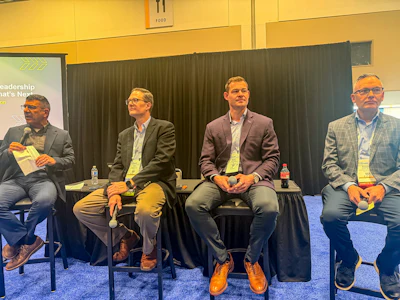
The grain processing industry stands at a pivotal moment, with leaders from major trade associations gathering at the 2026 GEAPS Exchange to discuss the future of grain handling and processing relationships. During a leadership panel, executives outlined priorities ranging from E15 implementation to managing unprecedented growth in soybean crushing capacity.
Robert White, senior vice president of industry relations at the Renewable Fuels Association (RFA), emphasized that E15 remains the organization’s top priority. “The number one priority, the number two priority, number three, four, five, seven through 10 is E15,” White stated. Despite ongoing legislative challenges, he highlighted existing opportunities, noting that over 50% of gas stations and 44% of fuel can already sell E15 year-round in seven states where governors took leadership roles.
The soybean processing sector is experiencing dramatic expansion, according to Devin Mogler, president and CEO of the National Oilseed Processors Association (NOPA). The industry has invested over $6 billion to expand capacity by more than 20%, with projections showing 62% of US soybean production will be crushed domestically in 2026. “This is all being driven by biofuels policy,” Mogler explained. “Historically, the oil, which is only 20% of the soybean, was only about 33% of the value. Now that oil share has reached 50%.”
Kurt Rosentrater, professor at Iowa State University, drew parallels to the ethanol industry’s early growth, when researchers questioned what to do with 10 million tons of distillers grains. “We figured it out,” he said. “But if we move to E15 and we increase our soy crush, we’re going to have a lot more protein meals that we’re going to have to find a home for.”
The panel addressed the critical need for stronger partnerships between grain elevators and processing facilities. White emphasized the symbiotic relationship: “This should be a partnership. Obviously there’s grain sitting at many locations around the country on the ground. When our facilities fill up, we turn to the elevators for support.”
GEAPS CEO John Caupert moderated the discussion, highlighting how the transformation benefits rural America. The panelists agreed that processing grain domestically rather than exporting whole commodities reduces dependence on foreign markets and strengthens agricultural communities.
Mogler reinforced this point, noting how domestic processing reduces reliance on China, which previously purchased 40% of US soybeans but now accounts for only 20%. “Strong biofuels policy means we are less reliant on China. Full stop,” he stated.
The session concluded with calls for enhanced collaboration between grain handlers and processors. White committed to attending future GEAPS events, while Mogler emphasized that all 20 NOPA members are also GEAPS members, creating natural opportunities for partnership.