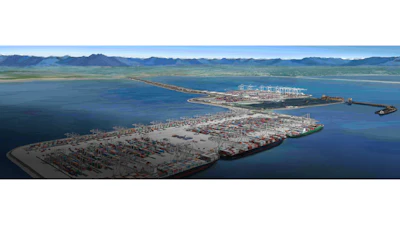
Canada launched the Vancouver Fraser Port Gateway Strategy, a major expansion plan that includes building Roberts Bank Terminal 2 to increase the Port of Vancouver's container-handling capacity by 50 percent, support $100 billion in annual trade capacity, and create over 17,000 jobs while protecting marine environments and respecting Indigenous rights.
- Roberts Bank Terminal 2 will add a three-berth marine container terminal on 320 acres, increasing container capacity by 50% and enabling $100 billion in new annual trade capacity
- The expansion is projected to contribute over $3 billion annually to Canada's GDP and support the creation of 17,000+ ongoing jobs across the supply chain
- The strategy addresses four main areas: container capacity expansion, bulk terminal development, rail infrastructure optimization, and environmental protections including $258 million over five years for whale and habitat conservation
- Roberts Bank Terminal 2 completed federal impact assessment in 2023 and is securing final permits; the port has Mutual Benefit Agreements with 27 First Nations
- The strategy supports Canada's goal of doubling exports to non-U.S. markets by 2035 and addresses decades-long capacity constraints at the country's largest port
The Canadian government announced a partnership with the Vancouver Fraser Port Authority to advance the Port of Vancouver Gateway Strategy, a plan designed to increase container-handling capacity and improve efficiency at the country’s largest port.
The strategy aims to support Canada’s goal of doubling exports to non-U.S. markets by 2035. The government is referring the strategy to the Major Projects Office and initiating the process toward potential listing of the Roberts Bank Terminal 2 project under the Building Canada Act.
Four-pillar approach addresses capacity constraints
The Gateway Strategy focuses on four main areas: expanding container-handling capacity through Roberts Bank Terminal 2, developing land for bulk terminals, optimizing rail infrastructure, and implementing environmental protections.
Roberts Bank Terminal 2, proposed for Delta, British Columbia, would add a three-berth marine container terminal on 320 acres of new industrial land. The expansion would increase the port’s container-handling capacity by 50 percent and enable $100 billion of new trade capacity annually while contributing over $3 billion to Canada’s GDP per year.
The project would support the creation of over 17,000 ongoing jobs across the supply chain during operations and relieve pressure on downtown terminals in the Burrard Inlet. The Vancouver Fraser Port Authority has Mutual Benefit Agreements in place with 27 First Nations.
Roberts Bank Terminal 2 has undergone more than a decade of environmental assessment and regulatory review, including consultation with Indigenous groups. The project successfully completed federal impact assessment in 2023 and is securing final permits required to begin construction.
Land development targets bulk export terminals
The port hosts 29 major marine terminals that handle grain, potash, petroleum products and canola oil. Dry and liquid bulk account for approximately 70 percent of total Port of Vancouver tonnage.
A shortage of industrial land at the port has discouraged investment in new terminals. Operators have kept existing terminals in service longer rather than building new, more modern and efficient facilities.
On July 20, the Vancouver Fraser Port Authority will launch a process to select an operator for its 40-acre Fraser Wharves terminal site in Richmond, the first major terminal opportunity at the port in a decade. The Major Projects Office may support the authority with this process to ensure the project advances efficiently while respecting Indigenous rights and safeguarding the environment.
Rail infrastructure strategy under development
The majority of cargo moving through the port is transported by rail. The current rail networks and supply chain infrastructure servicing the port will require investment to diversify Canada’s trade.
The Major Projects Office and Transport Canada are developing a rail infrastructure strategy to increase capacity and improve supply chain efficiency, reliability and resilience. The strategy will explore opportunities for investment in physical infrastructure and the optimization of gateway operations.
Environmental protections include whale conservation
The government committed more than $258 million over five years to renew and improve funding for the protection of whales and their habitats. This includes $95 million over the next five years and $16.5 million on an annual basis to protect Southern Resident killer whales and their habitat along British Columbia’s coast.
On April 7, 2026, the Minister of Fisheries announced $412.9 million over five years to renew the Pacific Salmon Strategy Initiative. The initiative will enable continued protection and recovery of wild Pacific salmon stocks of greatest conservation concern.
Through the Oceans Protection Plan, launched in 2016, the federal government has invested $3.5 billion in strengthening incident response, improving navigation safety, restoring coastal habitat and developing Indigenous partnerships.
Building Canada Act provides regulatory pathway
The Building Canada Act aims to ensure that projects of national interest can move forward efficiently through a coordinated process that improves regulatory certainty and investor confidence while protecting the environment and respecting the rights of Indigenous peoples.
If Roberts Bank Terminal 2 is listed under the act, it would provide immediate confidence that certain federal regulatory authorizations and permits will be granted, subject to the identification of appropriate conditions. Before any decision on listing is taken, consultations will be undertaken with potentially impacted Indigenous groups in the coming weeks.