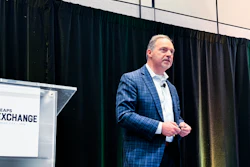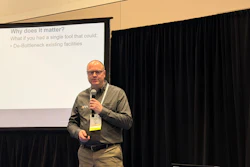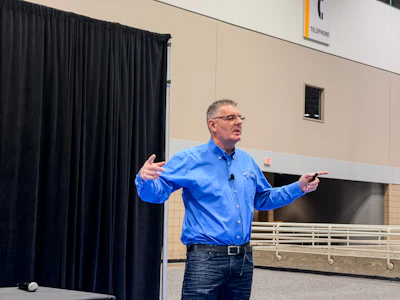
At the 2026 GEAPS Exchange, Kent Wingert, product manager at OPI Systems Inc., led an insightful education session showcasing current innovations in grain monitoring and automated conditioning. His presentation underscored the critical role of technology in maintaining grain quality, improving operational efficiency and reducing risks in grain storage environments.
“Effective moisture measurement is the backbone of grain quality management,” Wingert explained, emphasizing how precise monitoring helps prevent spoilage and preserve value. He detailed how modern sensors and monitoring systems offer real-time data, enabling operators to proactively manage grain conditions rather than reactively respond to problems.
A key highlight was the integration of automation to optimize conditioning processes. Wingert noted, “Automated systems make the conditioning process more reliable and consistent, reducing human error and operational downtime.” By synchronizing moisture readings with ventilation controls and aeration fans, facilities can maintain ideal grain conditions continuously without manual intervention.
Wingert also addressed the industry’s growing demand for smarter, connected solutions. “Data accessibility and ease of use are no longer optional,” he said. “Operators require systems that integrate seamlessly with their existing infrastructure and provide actionable insights at their fingertips.” The new generation of grain monitoring platforms is designed with user-friendly interfaces and mobile accessibility, helping operators track grain health remotely and efficiently.
The session covered benefits beyond quality control. Automated conditioning can significantly cut energy costs and improve worker safety by minimizing the need for manual checks in hazardous environments. Wingert shared, “Reducing the frequency of manual grain pit entries not only saves costs but also prevents potential injuries.”
Attendees were encouraged to consider the financial and operational advantages of investing in advanced monitoring equipment. Wingert concluded with a call to action: “Embracing automation and real-time monitoring is no longer a luxury — it’s a necessity for staying competitive and sustainable in today’s grain industry.”
This session resonated strongly with participants eager to leverage technology in their operations. As grain elevators and processors face increasing pressures to maintain quality while controlling costs, the integration of automated conditioning and sophisticated monitoring stands out as a practical and effective solution.