.jpg?auto=format%2Ccompress&crop=faces&fit=crop&h=48&q=70&w=48)
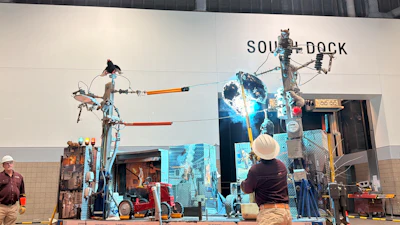
The crackling sound of 7,200 volts arcing through a hot dog might seem like an unusual way to start a safety presentation, but for Andy Connell, public safety manager at Evergy, it’s one of the most effective ways to demonstrate what electrical contact can do to the human body.
 An electrical current going through a dummy during "Electrical Hazard Demonstration: WATT Could Go Wrong" demonstration at GEAPS Exchange 2026.Steven Kilger
 A hotdog cooked from the inside out in seconds by an electric arc.c"Electrical Hazard Demonstration: WATT Could Go Wrong" demonstration at GEAPS Exchange 2026.Steven Kilger
Understanding the 10-foot rule
One of the most critical safety principles Connell emphasized is maintaining proper distance from power lines. “You’re supposed to stay 10 feet away from any energized high voltage power lines, and high voltage is anything over 600 volts,” he explained. “The 10-foot rule doesn’t just apply to the wire that you think may be the hot one.”
The demonstration showed how electricity takes multiple paths to reach ground, not just a single bolt as many people imagine. When balloons were floated into the power lines, the resulting arc etched paint off multiple areas, illustrating how current spreads across all available paths.
The hidden danger of step potential
Perhaps the most eye-opening demonstration involved step potential, the invisible electrical field that can extend up to 30 feet from an energized object touching the ground. “If you throw a rock in a pond, you get ripples going away from that,” Connell explained. “The center of that where you threw the rock, you can think of that as where the tractor’s sitting and the power is going to ground.”
This phenomenon creates rings of different electrical potentials around an accident site. Taking a normal step could place one foot at a different voltage level than the other, causing current to flow through the body instead of across the ground.
Generator safety: A critical oversight
The demonstration also highlighted a dangerous practice involving backup generators. Improperly wired generators using “suicide cords,” extension cords with male plugs on both ends can backfeed power through home electrical systems and energize power lines that workers assume are dead.
“It gets that 120 from your little generator, steps it up, goes up to 7,200 volts, sends it on down the wire,” Connell warned. “There could be linemen trying to put the wires back up. It could be you guys out there trying to clean up after storm damage, and you go, ‘Well, there’s no lights on anywhere. We should be fine.’”
The demonstration showed that even a tenth of an amp, well below what most people would consider dangerous, contains enough current to stop a human heart, which only requires 75 to 100 milliamps.
Essential electrical safety tips
- Maintain the 10-foot rule: Stay at least 10 feet away from all power lines, regardless of which wire appears to be energized
- Never assume downed lines are dead: Power lines lying on the ground may still be energized even if they’re not sparking or smoking
- Use proper exit techniques: If your equipment contacts power lines, stay in the vehicle if possible. If you must exit, jump clear without touching the vehicle and ground simultaneously
- Shuffle, don’t step: After exiting energized equipment, keep feet together and shuffle away at least 30 feet to avoid step potential
- Install proper generator disconnects: Use transfer switches or double-throw boxes to prevent backfeeding power into utility lines
- Call before you dig: Always contact utility location services before excavating, even in familiar areas
- Inspect protective equipment: Regularly check and replace electrical safety equipment according to manufacturer specifications
- Assume conductivity: Treat all materialsas potentially conductive around electrical hazards