 Alex Thomasson, professor and director of the Agricultural Autonomy Institute at Mississippi State University.
Alex Thomasson, professor and director of the Agricultural Autonomy Institute at Mississippi State University, authored the brief. He synthesized current research to assess where AI adoption stands today and what gaps in federal policy, infrastructure and workforce development must be addressed.
“Artificial intelligence has advanced so fast that it’s not really just a research tool anymore; it’s embedded in agricultural practice now,” Thomasson said. “From autonomous weed spraying to AI-assisted seed selection to real-time food safety inspection on processing lines, the technology is already changing how farmers work, how food moves through the system, and what we expect from that system. The policy conversation needs to catch up.”
The brief identifies five main findings. AI is already in active use across crop production, animal agriculture and food supply chains. The technology is evolving from a data analysis tool to what the brief calls “physical AI,” with autonomous machinery moving from demonstration to commercial deployment. Data quantity and quality are foundational to AI performance, making rural data infrastructure a critical policy priority.
“How AI develops, how it is used in agriculture, and who has access to it over time are going to be heavily influenced by policy decisions, many of which are made by legislators,” Thomasson said.
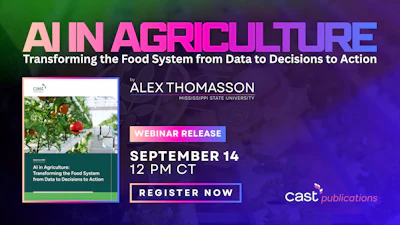
CAST will host a free public webinar on Sept. 14 at noon CT.