America's grain infrastructure is reaching a critical decision point. Across the Midwest and beyond, elevators built during the construction boom of the 1930s through the 1960s are reaching a point where owners must decide whether continued investment still makes sense. While many continue operating safely, others have been decommissioned, leaving owners to weigh a difficult question: Is it better to preserve, repurpose or demolish an aging facility?
The answer depends on a combination of economics, safety and future operational needs. Although modern grain handling demands faster, higher-capacity facilities than ever before, tearing down an aging elevator is rarely a simple or inexpensive decision.
"There certainly is a large number of elevators in the grain industry that could come down because they're no longer being used or have become completely antiquated," said Ben Breazeale, engineering manager for The Andersons in Maumee, Ohio.
Many of those facilities were built when handling capacities of 5,000 bushels per hour were considered efficient. Today, producers and the rest of the grain value chain increasingly expect receiving and loadout systems capable of moving 30,000 to 40,000 bushels per hour or more.
"If you were starting with a clean sheet of paper today, you'd build a fast, modern facility with high-speed equipment," Breazeale said.
Jason Bevans, demolition manager for CL Construction LLC, sees the same trend from the demolition side of the industry.
"Many of the facilities we see have been sitting unused for years," Bevans said. "Customers are reaching the point where maintaining older structures no longer makes economic sense."
Even so, Breazeale emphasized that the need for specialized demolition services does not necessarily mean every aging elevator should come down. Before undertaking a project with little direct financial return, owners need a compelling reason to remove a structure.
How to decide when demolition makes sense
For many owners, the first question isn't how to demolish an aging elevator — it's whether demolition is necessary at all.
"In many cases, the best solution is simply to leave the structure alone," Breazeale said.
Many elevators built as early as the 1930s and 1940s have been retired from service but remain standing. While those facilities no longer meet today's operational demands and are unlikely to be upgraded, they also aren't creating immediate problems.
Because demolition can be a significant expense with no direct return on investment, leaving an unused structure in place is often the most practical financial decision.
The equation changes, however, when an aging elevator limits future growth.
"If you need the real estate for another scale, an office, a new facility or a ground pile, then demolition often makes sense," Breazeale said.
Safety concerns can also make the decision unavoidable. Spalling concrete, deteriorating structural components or other signs of instability may require prompt action before the risk escalates.
Public safety is another consideration. Many older elevators are located near communities, and vacant structures can attract trespassers, including children. In those cases, the facility must either be secured or removed.
Recognizing the warning signs of structural deterioration is an important part of deciding when demolition becomes the best option.
Dalton Rouse, demolition estimator and project manager for CL Construction, said most grain structures his company removes have experienced some form of structural failure.
"Older concrete bins typically contain more horizontal than vertical reinforcement," Rouse said. "As they age, horizontal cracking can develop, eventually leading to structural failure."
He recommends routinely monitoring exterior cracks and assessing whether structures remain sound. While those inspections require continued investment, they help owners make informed decisions about whether a facility can safely remain in service, should be decommissioned or has reached the point where demolition is the most responsible option.
Safety and risk management
Once the decision has been made to remove an aging structure, the focus shifts from evaluating the facility to managing the risks of demolition itself. Unlike new construction, demolition involves dismantling structures with unknown conditions, making careful planning and oversight essential from the outset.
"The biggest risk by far is safety," Breazeale said. "Demolition is inherently unpredictable because you don't always know how a structure will react once you start removing components. The more a contractor focuses on identifying and mitigating those risks, the more confidence we have in the project."
According to a white paper from Berkley Agribusiness, an insurance solutions provider serving commercial agribusiness, many of the most consequential decisions on a demolition project are made long before heavy equipment arrives on-site.
Developing a detailed work plan should be the first step in any risk management strategy. Breazeale recommends asking prospective contractors detailed questions about every phase of the project, including where demolition will begin, how materials will be removed, how debris will be handled and how work will progress from start to finish.
Those conversations do more than establish expectations — they can also help clarify responsibility if something goes wrong.
The Berkley white paper notes that construction and demolition claims are particularly complex because multiple contractors, subcontractors, engineers and inspectors often work simultaneously under separate contracts and safety programs. Without clearly defined responsibilities, facility owners may assume risk has been transferred to a contractor when it has not.
To reduce that exposure, Berkley recommends documenting indemnification language, verifying insurance limits — including subcontractor coverage — and requiring written safety plans and training documentation. When standard contracts don't adequately address project-specific risks, the report advises having supplemental agreements reviewed by a licensed attorney.
The report also cautions that signing a contract does not automatically eliminate an owner's liability. Companies that provide equipment, issue permits or allow employees to work near contractor operations may still share responsibility if an incident occurs.
Risk management also continues after demolition begins. Operations and engineering personnel should remain actively involved throughout the project.
For the demolition contractor, planning should begin well before the first piece of concrete is removed.
Rouse said structural scanning technology can be used to determine each structure's center of stability before developing a demolition sequence. That information helps crews safely plan how the structure will come down while coordinating debris removal and identifying recyclable materials.
The company also establishes controlled access zones around each project —designated areas where falling debris could pose a hazard. Work plans identify those zones, outline communication procedures and document each phase of the demolition process before work begins.
Why specialized contractors matter
Selecting the right contractor can be just as important as deciding to demolish in the first place. Grain elevators present structural and operational challenges that differ significantly from other commercial or industrial buildings, requiring specialized equipment and experience.
Throughout his career, Breazeale said one of the industry's biggest challenges has been finding contractors who understand grain facilities and can safely dismantle them.
"It's specialized work," he said. "Not every demolition contractor has the equipment or the experience to safely take down a grain elevator."
CL Construction launched its demolition division in 2024 after its owner purchased a decommissioned grain facility at 3001 Cornhusker Highway in Lincoln, Nebraska.
"Our original goal was simply to remove the facility and repurpose the property," said Adam McLaughlin of CL Construction. "Once we started that project, we realized there was a much larger need in the marketplace."
According to Bevans, roughly 90% of its demolition inquiries come from grain companies and cooperatives looking to remove aging facilities that no longer justify the cost of repair. The remaining projects involve developers preparing former elevator sites for redevelopment.
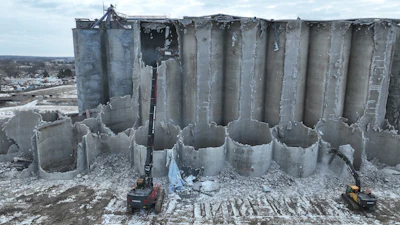
A key driver of the demolition division is its Volvo high-reach demolition excavator, which can reach approximately 120 feet while dismantling structures from the top down.
Rather than weakening the structure from the bottom up, the top-down approach allows crews to remove the highest portions first while maintaining structural stability throughout the demolition process, reducing risk to workers and surrounding property.
Looking ahead
America's grain infrastructure will not be replaced overnight. Many elevators built decades ago continue to serve producers well, while others have been retired but remain standing because demolition simply isn't justified.
For facilities that have reached the end of their useful lives, however, owners are increasingly balancing the cost of maintaining aging infrastructure against the benefits of modern, higher-capacity operations. When demolition becomes the right choice, success depends on more than heavy equipment. It requires thoughtful planning, clear contractual responsibilities, experienced contractors and an unwavering commitment to safety.
As the industry continues to modernize, more grain companies will find themselves at this crossroads. Knowing when to preserve an aging asset — and when it's time to safely clear the way for what's next — will become an increasingly important part of managing grain infrastructure for decades to come.