Feed manufacturers are navigating one of the most significant technological inflection points in the industry’s history. For decades, tools to optimize formulation in real time, predict equipment failures before they occurred or simulate an entire facility's operation in a virtual environment simply didn't exist at a practical or affordable scale. That is no longer the case.
Today, artificial intelligence (AI) platforms capable of processing hundreds of operational variables simultaneously are commercially available. Digital twin implementations that once required years and significant budgets can now be developed in months. Enterprise AI tools trained on vast bodies of published research on nutritional data and process engineering specific to feed manufacturing are accessible to any operation with an internet connection and a licensing agreement.
Feed mills can deploy predictive maintenance systems to extend equipment life, reduce unplanned downtime and move away from costly calendar-based service intervals toward data-driven decisions. Operations can implement AI-assisted formulation tools to identify cost-saving ingredient substitutions that once would have taken weeks of manual analysis to surface. Facilities with high-level process autonomation can implement closed-loop control systems that make real-time adjustments without operator intervention.
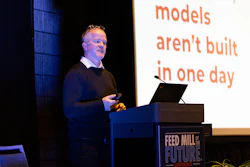
With almost limitless possibilities, the obstacle, as a panel of six experts discussed at the 2026 Feed Mill of the Future Conference, is organizational. Companies must be willing to honestly audit their existing data systems, invest in modern infrastructure, build AI literacy internally and approach implementation as an ongoing strategy rather than a one-time project.
The panelists painted a clear picture of the most consequential technology trends impacting feed mills today and what mills need to do to prepare for the future.
1. Data infrastructure auditing
No technology trend on this list delivers value without it, and yet, data infrastructure remains under addressed in feed manufacturing. Before a mill can benefit from AI, it must answer the basic questions: do we know what data we have, where it lives and whether it's actually usable?
Brian Sokoloski, chief technology officer for Easy Automation Inc., said the essential first step is "taking a very big look at your system as a whole — not just a single segment of it — start to finish."
“I think, this is where we really need to focus on the start, and then all the other really valuable stuff can pile on afterwards," he said.
Nick Malott, analytics architect at Interstates, said data accessibility is the most common obstacle he encounters when helping facilities implement predictive maintenance.
“Is your data being recorded?” Malott said. “Do you have history of that data? Is it accessible to other platforms? And are you able to contextualize that data between different systems? Getting that holistic data picture is definitely one of the biggest challenges.”
The challenge runs deeper for operations housing data on outdated hardware. Jake Joraanstad, CEO of Bushel, observed how little has changed since he founded his company in 2017, with AS400 green-screen systems still running operations across much of the industry.
"The problem with those systems is that you can't work with that information, even if you have perfectly clean data," he said. "The minute that you hook up any of these more powerful tools, these things just fall over."
The panel’s advice is to audit your data landscape before investing in anything else, move toward cloud-based infrastructure that can scale and resist the temptation to simply upgrade to the next on-premise solution.
David Pelsoci, managing partner of Captios Partners, warned against skipping the discovery phase to avoid making a costly mistake.
The discovery phase "will help you form a more realistic business case," he said, "as opposed to skipping that, believing that the ROI is there, getting to the later stages of development and then figuring out you've got big gaps in your data."
2. AI shifting from novelty to operational tool
AI has moved from buzzword to business utility. The panelists agreed feed manufacturers should stop treating it as a meritless technology and start using it today. The most practical entry point is enterprise-level AI tools that employees are already using on their own time.
Joraanstad said that while most people in the feed industry today admit they use AI tools personally, they probably don’t use the same tools at work — despite how useful they are.
“The moment that your company turns the table and says, ‘We're going to let the team in-house use these tools on their phones and on their computers at the office,’ is the moment that this sort of dark, magical thing called AI becomes very clear to everybody,” he said. “’Oh, I see how this can help me.’”
On the security concerns cited by IT departments that often stall adoption, Joraanstad said the distinction between free models and enterprise tools makes all the difference.
"If the tool is free to you to use, nothing is free in life, so therefore you are giving it your data and training it," he said. "But if you have an enterprise tool and a license that you're paying for, in general, you'll find that those tools are not using your data to train — and that's a good thing."
Karel Vervaet, senior product specialist at BESTMIX, encouraged mills to approach the learning curve without fear.
“Just try it,” he said. “There’s no such thing as failure. If you give a bad prompt, you give a bad prompt, and then you learn from the prompt. Five years from now, nobody’s going to ask the question anymore ‘What if somebody is not familiar with AI?’ Everybody’s going to use it.”
One important caveat for smaller operations is that AI-driven feed formulation tools require large volumes of data to train effectively. Vervaet noted that a single-mill operation running 200 to 300 recipes per year will face real limitations compared to a multinational operating 50,000 to 70,000 recipes globally.
"For the big companies, it will be a lot easier because they have way more of their own intellectual property than the smaller companies," Vervaet said.
3. Maintenance progressing toward predictive and prescriptive
Fixed maintenance schedules are giving way to AI-powered systems that monitor equipment conditions in real time, weigh risk variables and recommend or even initiate service at the optimal moment. For feed mills, where unplanned downtime can cascade into production holds and significant financial losses, this shift carries substantial practical value.
"You have to understand what your critical equipment is, what the risk is that it's going to fail and what are you willing to bet that it'll keep going for slightly longer than that preventive maintenance schedule dictates," Malott said. "It's a little bit of hedging."
Ranjit Maharajan, head of product group for automation solutions at ANDRITZ, said AI’s edge comes from its ability to process complexity at a scale humans cannot match.
"Over time, you can put in models that can look at hundreds of different parameters — it may not be just one that's influencing this decision," he said. "Usually humans can't compete with this, and that's where AI models come in."
Sokoloski noted that the most sophisticated maintenance models will eventually incorporate external data — weather, supply conditions and more — that human operators would never think to factor in.
4. Digital twin modeling
Digital twin technology — virtual replicas of physical facilities used for simulation, training and optimization — has matured significantly and is increasingly accessible to feed manufacturers. Despite a reputation as cutting-edge, panelists noted the underlying technology has existed for more than 20 years. What's changed is the cost and speed of implementation.
Pelsoci said implementations can begin in as few as three months for smaller facilities using pre-built models, though scope and site count add to the timeline considerably. What’s more important than speed is adjusting the fidelity of the model to the actual business need, noting that mills can start with existing data — even if imperfect — and refine the model over time.
"Perfection is the enemy of progress," Pelsoci said.
Maharajan echoed his point, noting that higher fidelity models can cost exponentially more, but don't always deliver proportionally better outcomes.
"There are certain industries like aviation where you need 99% fidelity," he said, "but there are fields where getting to 95% or 99% fidelity doesn't make that much of a difference when you can get away with 90%."
Both emphasized that digital twin implementation is never truly "finished." Pelsoci challenged the assumption that technology projects have a defined end point.
"This is an asset that requires maintenance and ongoing investment to continuously get more out of it," he said. "This idea that your investment is done would be a very dangerous way to view it."
5. Reaching 'lights-out': Autonomous operations
The most forward-looking trend is the push toward highly autonomous feed mill operations. Maharajan outlined a five-level autonomy scale, drawing a parallel to the automotive industry's development of self-driving vehicles.
He said most feed mills operate around Level 3 automation, where closed-loop control systems handle routine decisions without constant operator input, but humans remain actively involved in managing the process.
The industry's realistic near-term target is Level 4 — facilities that largely self-manage, with human involvement focused on maintenance and exception handling rather than moment-to-moment decisions.
"Two years ago, if somebody asked me when this will happen, I would say 10 years," Maharajan said. "But now I feel like three to five years is definitely possible."
The urgency behind that push is as much about workforce as it is about efficiency.
"There's literally more work than we have people to do the work, and it's only going to get worse in the next 20 years," Joraanstad said. "In order to solve that without paying too much for labor you can't afford is to maximize automation on most of your work. The best facilities will be the ones that are the most automated. Your end result needs to be lights-out facilities that just work."
Across all five trends, data strategy, organizational readiness and the willingness to start are what separate the mills that will lead from those that will lag.
And the beauty is the feed industry doesn't need to fund the research and development for this transformation. The investment flowing into data center builds, foundation model development and enterprise AI infrastructure across the U.S. and globally will directly benefit feed mills.
"There's nothing that this group in this room will be able to do at your company to match the hundreds of billions and trillions of dollars being invested in this space right now,” Joraanstad said. “We need to piggyback on that."
Every capability improvement in the underlying AI platforms, reduction in cloud computing costs and advancement in predictive modeling or natural language interfaces make the tools available to feed mills more powerful, accessible and affordable. Feed mills must simply be ready to put the results to work in formulation, maintenance, logistics and workforce efficiency.