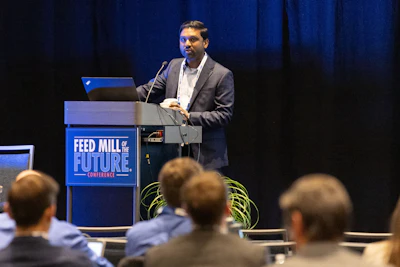
In today's feed mill environment, operators face overwhelming challenges everyday managing increasingly complex systems across multiple screens while shouldering responsibilities that once required several people. Ranjit Maharajan, head of product group - automation solutions for ANDRITZ, spoke about a solution to this digital overload at the Feed Mill of the Future Conference during the International Production & Processing Expo (IPPE) in Atlanta on January 27.
According to Maharajan, feed mills face serious operational risks that the industry can no longer ignore.
"There are tons of information that one operator has to look at — sometimes up to 10 different systems,” Maharajan said. “It's too much."
Maharajan explained during his presentation that operators who monitor command centers often react only once alarms sound — by which point problems have already escalated.
The challenge stems from multiple factors: systems growing more complex as new technology layers onto existing infrastructure, rising operational demands as companies pursue lean manufacturing and single operators expected to handle tasks previously distributed among several people. The results is feed mills struggling to maintain production while managing upset conditions and troubleshooting across multiple systems.
A growing training gap
The problem extends beyond day-to-day operations into a critical training deficit. With approximately 25,000 feed mills globally averaging seven operators each and facing 15% annual turnover, the industry sees roughly 26,000 new operators entering feed mills every year, according to Maharajan. Traditional training methods — work shadowing, allowing operators to learn independently and learning through mistakes — prove both expensive and inefficient.
These approaches leave operators underprepared for the complex scenarios they'll encounter. Unlike other high-stakes industries that invest heavily in comprehensive training programs, feed mills have lacked access to cost-effective advanced training technologies.
Aviation technology comes to feed mills
ANDRITZ has adapted proven aviation simulator technology to address this challenge. Drawing parallels to how pilots train for emergency scenarios in flight simulators, the company developed a high-fidelity Operator Training System (OTS) specifically for feed mill operations.
Maharajan explained the aviation analogy: pilots must train for scenarios like water landings despite their rarity, going through hours of simulator training in environments that replicate their actual cockpits down to every switch and screen. This training builds confidence and competency through practice in a risk-free environment.
"We develop a high fidelity process model, which replaces the actual process out in the field," Maharajan said. “Then we have an emulator. The emulator would be acting like your IOs, and then we provide the exact same operate interface.”
The system uses sophisticated mathematical modeling based on steady-state and dynamic principles, stoichiometric calculations, chemical reactions and particle size distribution to replicate real-world conditions. ANDRITZ engineers build these models using plant data, process and instrumentation diagrams, layout drawings, data sheets and historian data.
How the simulator works
OTS operators cannot distinguish the simulator from actual plant operations. The simulator calculates everything in real time across all equipment — pellet mills, conditioners, and other machinery — accounting for upstream and downstream conditions. Each piece of equipment has its own high-fidelity mathematical model that mimics real-life scenarios by calculating physics, flow dynamics and equipment behavior.
And the system isn't static — it continuously adjusts parameters based on different scenarios, creating a truly dynamic training environment. An instructor station allows supervisors to assign specific training modules tailored to individual needs — some operators might focus on front-end operations while others concentrate on backend processes.
"The beauty is that they can actually take this hundreds of times,” Maharajan said. “They can fail, but they can fail safely. Then they feel more confident."
This safe-fail environment builds operator competency through repeated practice across various scenarios, including upset conditions they might never encounter otherwise.
The training combines theoretical courses covering operational basics with practical simulation exercises. Operators work at their own pace, and the system tracks everything — every click, every decision — allowing supervisors to review performance and provide targeted feedback. Training certificates document completed programs, creating formal records of operator qualifications.
Adding artificial intelligence
ANDRITZ has taken the technology further by partnering with Microsoft to integrate Copilot, creating what the company calls Smart OTS. This AI-powered assistant operates within the control room operator station, providing real-time guidance by analyzing historical data and current conditions.
The copilot monitors production continuously. When it detects issues — such as production running below historical averages for a particular recipe — it proactively alerts operators and provides context. If current production is 18.3 tons per hour while historical average is 19.8, the system flags the discrepancy and suggests corrective actions based on current motor loads and operating conditions.
"It's so powerful that the operators are not only empowered with this data, they can make decisions in real time and they can make decisions very confidently," Maharajan said.
Beyond production optimization
The AI assistant even extends into predictive maintenance. When sensors detect anomalies like high vibration in pellet mill drive shafts, Copilot analyzes patterns against historical data to diagnose potential causes — perhaps misalignment — and retrieves relevant recommendations from service manuals and maintenance documentation.
The system draws from multiple connected data sources including computerized maintenance management systems and ERP platforms. The more systems connected, the more powerful the analysis becomes. Operators can conduct conversational queries, requesting custom analyses like heat maps showing production variations or pellet durability index trends across different parameters — tasks that previously required hours of work.
Measurable impact
The combined impact of simulator training and AI-powered decision support proves significant.
"We have seen at least 10 - 15% increased production because the operators are able to push their limits," Maharajan said.
Operator competency also increased 35 to 50% after completing simulator training programs. Perhaps more importantly, the technology democratizes expertise across experience levels.
"We don't have to depend on the tribal knowledge anymore," Maharajan said. “We don't have to depend on somebody's 20 or 30 years of experience to operate in the best way. Everybody, even the new operators, can do better now.”
Technology reaching critical mass
Maharajan emphasized that while simulator technology has existed in other industries for years, it remained too expensive for widespread feed mill deployment. Recent advances in AI and large language models have changed the economics, making sophisticated operator support systems viable at feed industry scale.
By combining human expertise with digital intelligence, ANDRITZ aims to transform feed mill operations through smarter decision-making, enhanced safety and sustainable growth — bringing tools once limited to high-stakes industries like aviation into practical reach for feed manufacturers worldwide.