Most nutritionists are trained to balance nutrients, not to operate batching scales or adjust pellet dies. We learn digestibility systems, amino acid ratios and matrix values. We become comfortable with least-cost software and decimals. We can fine-tune lysine in seconds and optimize phosphorus to the third decimal place.
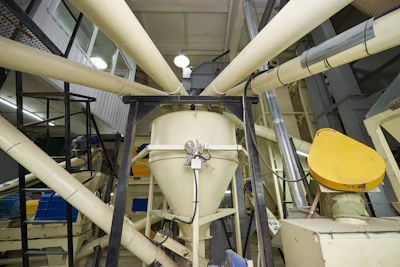
Then the formula arrives at the feed mill. And that is where reality begins. A diet can be perfectly balanced on paper and yet poorly suited for manufacturing. This is not a failure of nutrition, nor of the mill. It is usually a failure of integration and alignment. A formula is not a feed until it has been manufactured at an actual feed mill.
Precision on paper vs. limits in batching
One common issue is ingredients added at levels that cannot realistically be weighed with the accuracy assumed in formulation. Including an ingredient at 0.7 lb per ton — or less — looks precise in software. In practice, many batching systems struggle to consistently deliver such inclusion levels, especially when several micro-ingredients are involved.
Even when equipment is technically capable, throughput pressure and normal operating variation introduce error. We formulate as if every decimal matters, but the mill operates within mechanical tolerances. When inclusion levels fall below practical batching resolution, theoretical precision becomes operational noise.
The complexity trap
Modern formulation systems make it easy to include many ingredients at small inclusion levels. It is not unusual to see formulas containing 15 or 20 ingredients, several included at marginal rates to optimize cost or impress marketing and sales.
Each additional ingredient requires storage space, handling, inventory control and monitoring. Each one adds variability and increases the burden on batching and mixing systems. From a nutritional or marketing standpoint, the incremental benefit may be measurable. From a manufacturing standpoint, the added complexity may reduce robustness. Simpler formulas often perform just as well and are easier to execute consistently.
Formulas that resist pelleting
Pelleting is a mechanical process involving heat, moisture and pressure. Some formulas move smoothly through conditioning and pelleting. Others resist the process at every stage.
High-fiber diets, poorly balanced starch levels, or inadequate natural binders can reduce pellet durability. Excess fat interferes with conditioning and decreases pellet quality. Extremely fine particle distributions increase energy consumption and reduce throughput. A diet that performs well biologically but cannot be pelleted efficiently carries hidden costs that formulation software does not calculate.
Maillard reactions under heat
Heat improves pellet quality and feed hygiene, but it also introduces risk. Diets containing elevated levels of reducing sugars — from molasses, sugar or certain co-products — combined with reactive amino acids such as free lysine can undergo Maillard reactions during conditioning.
The analytical lysine value may remain unchanged, yet digestibility drops dramatically. When formulation ignores processing intensity, nutrient availability can suffer quietly. Animals respond to digestible nutrients, not calculated ones, and the difference often appears gradually rather than dramatically.
Handling challenges with fats and liquids
Liquid fats and molasses often appear attractive in least-cost formulation because they increase energy density and may improve palatability. On paper, the inclusion seems harmless.
In the mill, however, excessive levels create practical problems. High fat reduces pellet durability and causes build-up in mixers and dies. Elevated molasses increases stickiness, impairs flowability and complicates bin discharge. When feed does not move efficiently through the system, consistency suffers regardless of how elegant the nutrient profile may be.
Oxidation risk in modern formulations
Modern diets increasingly incorporate highly unsaturated fats and coproducts. These ingredients are more prone to oxidation during storage and heat exposure.
Without adequate antioxidant protection, lipid peroxidation can develop gradually. The consequences are subtle at first: reduced vitamin stability, off odors and compromised palatability. Because oxidation progresses quietly, it is often overlooked. Balancing energy does not automatically guarantee stability.
Segregation and uniformity
Physical characteristics matter as much as chemical composition. Diets containing ingredients with very different particle sizes or densities are prone to segregation during transport and handling.
Fine particles settle, while coarser particles migrate. The feed that leaves the mixer is not always identical to the feed that reaches the feeder. From a formulation perspective, the diet is balanced. From the animal’s perspective, intake may vary from mouthful to mouthful.
Bridging nutrition and manufacturing
The underlying issue is not incompetence, but separation. Nutritionists often formulate without fully appreciating mill constraints, while mills are asked to execute formulas that were never evaluated for practicality.
Feed quality lives in the overlap between these two disciplines. Nutritionists benefit from spending time in the mill — understanding batching limits, liquid systems, conditioning temperatures and storage realities. Mill managers benefit from understanding which nutritional constraints are critical and which are flexible.
Designing diets for animals — and for mills
A formula is not complete when the software reaches optimal cost. It is complete when it can be manufactured consistently and delivered uniformly to the animal.
Precision in formulation is valuable. But precision that cannot be executed is an illusion. If we want feeding programs that are robust under commercial conditions, we must design diets not only for nutrient adequacy, but also for mechanical reality. Because feed is not simply calculated. It is made.