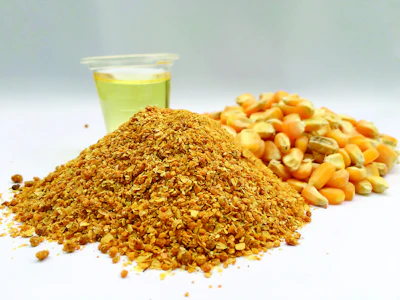
Distillers dried grains with solubles (DDGS) have been part of U.S. feed formulation long enough that many of us treat them as a fixed reference point. They feel familiar and are widely available and nutritionally understood. In practice, however, DDGS today are not quite the same ingredient many formulation systems were built around. This is not a story of DDGS becoming better or worse. It is a story of DDGS becoming different, and why that difference matters more now than it once did.
Early DDGS: Consistent identity, uneven execution
When DDGS first became widely available, ethanol production was relatively simple. Across plants, DDGS tended to share a broadly similar nutritional profile. Protein, fiber, fat and mineral ranges were reasonably predictable, even if they were not tightly controlled.
What varied more noticeably was quality execution. Drying conditions, heat damage, moisture control, flowability and storage stability could be inconsistent. Nutritionists and feed mill managers learned to manage these risks through experience, visual inspection and conservative assumptions.
Early DDGS could be unpredictable in quality, but they generally had a clear nutritional identity. Everyone knew what DDGS were supposed to be, even when the product did not always meet expectations.
Modern DDGS: Better control, broader definition
Today’s ethanol plants operate very differently. Processing is more precise, quality control is tighter and coproduct streams are often intentionally optimized. These changes have reduced many of the obvious quality problems seen in the past. At the same time, they have expanded what "DDGS” actually represents.
Oil extraction, fractionation and other processing steps have created products that still carry a familiar name, but no longer represent a single nutritional entity. Two products labeled as DDGS may look similar analytically and yet behave differently in animal diets. This does not mean modern DDGS are inferior. It means they are less uniform in nutritional function, even when they are well produced.
The definition gap
One of the main challenges with DDGS today is not analytical quality, but definition. Terms such as “low-oil DDGS” illustrate this well. The label accurately describes one attribute, but it does not fully describe how the ingredient behaves nutritionally.
Reduced oil content often coincides with changes in energy value, fiber characteristics and sometimes amino acid digestibility. The resulting product may still be high quality, but it is not nutritionally interchangeable with traditional DDGS.
The risk arises when familiar names imply familiar behavior. Historically, “DDGS” suggested a reasonably narrow nutritional role. Today, the same term can cover products with different nutritional functionality, although specifications appear acceptable.
Why this matters more now
DDGS have always varied. What has changed is the context in which they are used. Modern feeding programs operate with tighter margins, more frequent formulation changes and less tolerance for performance variability. Feed mills are expected to execute rapid changes without disrupting throughput. Performance expectations are high, and small deviations are noticed quickly.
In this environment, ingredient definition matters more than it once did. Assumptions that were once manageable can now introduce variability into otherwise well-controlled systems.
Different views of the same ingredient
Nutritionists tend to experience this shift through formulation challenges: adjusting constraints, revisiting energy values or explaining why two DDGS sources with similar crude protein do not perform the same way.
Feed mills experience it through handling behavior and process consistency. Procurement teams experience it through supplier differentiation and specification discussions.
Managers and executives often experience it indirectly — as reduced predictability. Average performance may remain acceptable, but variation increases and confidence erodes quietly.
These are not separate problems. They are different expressions of the same underlying change.
What this means for feed formulation
The implication is not that DDGS should be avoided, nor that earlier DDGS were fundamentally flawed. It is that DDGS can no longer be treated as a single, well-defined ingredient.
Using DDGS effectively today increasingly requires:
- Distinguishing among DDGS types and sources
- Focusing on nutritional identity, not just specifications
- Recognizing that processing changes affect functionality
- Valuing consistency as part of formulation risk management
This represents a shift in thinking more than a shift in ingredients.
Adapting to a more complex ingredient
DDGS remain an important and valuable feed ingredient. Their evolution reflects changes in ethanol production and market demands, not a failure of the co-product itself.
The challenge for the feed industry is to keep assumptions aligned with reality. When ingredient names no longer guarantee nutritional identity, formulation must move from familiarity to understanding. That adjustment is not a criticism of the past. It is a necessary response to the present.
WEB BOX
High-yeast DDGS may improve digestibility, reduce cost www.FeedandGrain.com/15539956