Georgia Ports Authority opened its $134 million Gainesville Inland Port on October 29, a rail terminal connecting Northeast Georgia shippers directly to the Port of Savannah through Norfolk Southern service, with capacity for 200,000 containers annually and potential to remove 18 million truck-miles from Georgia roads in its first year.
- The $134 million Gainesville Inland Port began operations May 4, 2026, and held its grand opening October 29 with Governor Brian Kemp in attendance
- Terminal capacity reaches 200,000 containers at full build-out with 26,000 containers expected to shift from truck to rail in the first year
- Rail service eliminates a 600-mile round-trip truck route and removes 18 million truck-miles from Georgia roads annually, cutting carbon emissions by 90%
- Located on 104 acres with five days weekly rail service between Gainesville and Savannah, connecting to 40 weekly vessel calls at Port of Savannah
- Part of GPA's $5 billion, 10-year expansion plan including new container berths at Savannah and Brunswick ports, with the $2.3 billion Savannah Container Terminal opening mid-2030s
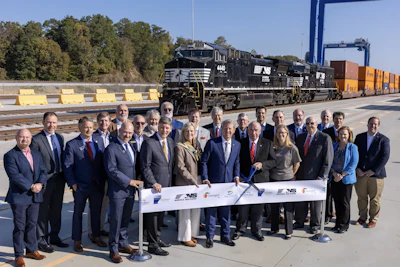
The Georgia Ports Authority (GPA) held a grand opening ceremony Oct. 29 for its $134 million Gainesville Inland Port, a rail terminal that connects Northeast Georgia shippers to the Port of Savannah through direct Norfolk Southern service.
Gov. Brian Kemp joined customers, Hall County officials and port leaders at the event, according to a GPA release. The terminal has been operating since May 4, 2026, according to GPA's facility page, and will have an annual capacity of 200,000 containers at full build-out. GPA expects to shift 26,000 containers from truck to rail in the terminal's first year.
"Georgia's ports are a major reason companies choose to invest and create jobs here, and the Gainesville Inland Port brings that advantage directly to Northeast Georgia," Kemp said.
Farm and forest exports
The terminal sits on 104 acres, with rail service five days a week between Gainesville and Savannah, according to Norfolk Southern. It links customers to the Port of Savannah's 40 weekly vessel calls.
Imports handled so far include home and retail goods and manufacturing components. Exports consist of farm and forest products, along with manufactured goods, GPA said. The authority lists poultry, heavy equipment and forest product companies among the local manufacturers using the service to reach international markets.
Northeast Georgia has a consumer market of 2 million people and more than 300 manufacturers, according to GPA. Since 2020, 78 new and expanding firms have added more than 4,800 jobs and $2 billion in capital investment to Gainesville-Hall County. Manufacturing, processing and logistics make up the area's largest employment segment, at 33% of the workforce.
"We view this as a high growth market where we can improve supply chain performance and make customers more competitive long-term. We're bringing the Port of Savannah closer to Gainesville," GPA CEO Griff Lynch said.
Rail or truck
Customers can choose rail for lower cost and heavier loads, or truck-only moves for faster transit. The rail service offers an alternative to a 600-mile round-trip truck route, according to GPA.
The authority estimates the terminal will remove 18 million truck-miles from Georgia roads in its opening year, rising to 43 million truck-miles in 2045, and eliminate 52,000 truck trips through Atlanta. GPA said the shift to rail will cut carbon dioxide emissions by 90%, or 22,510 metric tons, compared with an all-truck route in the first year.
Trucks reach the terminal from interstates 85 and 985. On-terminal storage and truck gates are open 7 a.m. to 8 p.m. Monday through Friday. Because containers are grounded rather than kept on wheels, customers can reduce chassis fees compared with wheeled storage at their own facilities, GPA said. The terminal will be served by 14 hybrid electric rubber-tired gantry cranes at full build-out.
Ed Elkins, chief commercial officer at Norfolk Southern, said the terminal gives the region's manufacturers and distributors another route to global markets.
"By bringing the Port of Savannah closer to the manufacturers and distributors in this region, we're giving customers another efficient, scalable way to reach global markets while helping reduce truck traffic on Georgia's highways," Elkins said.
Local road work
GPA funded $4.8 million in Hall County road projects tied to the terminal. The work eliminated an at-grade rail crossing, rerouted White Sulphur Road and resurfaced Cagle Road. The new White Sulphur route south of the terminal gives emergency vehicles access without delays from trains.
"We are working with customers and the logistics community to create more business opportunities for them," GPA President Kevin Price said.
Part of a $5 billion plan
The Gainesville terminal is part of GPA's $5 billion, 10-year plan, which adds five container berths at the Port of Savannah and one roll-on/roll-off berth at the Port of Brunswick.
GPA plans to start construction in 2028 on the $2.3 billion, 350-acre Savannah Container Terminal, with capacity for 3.5 million twenty-foot equivalent units (TEUs) and an on-dock rail terminal. When it opens in the mid-2030s, the Port of Savannah's total container capacity will reach 12 million TEUs, according to GPA.