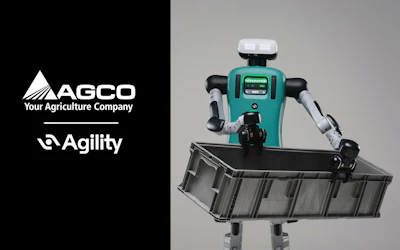
AGCO has partnered with Agility Robotics to pilot the Digit humanoid robot at its Hesston, Kansas manufacturing facility starting in 2027, with the robots handling repetitive and physically demanding tasks like sorting, stacking, and material handling to improve worker safety and operational efficiency while keeping humans in skilled roles.
- AGCO signed a commercial agreement with Agility Robotics to test Digit humanoid robots at its Hesston, Kansas plant, with the pilot beginning in 2027
- Digit robots will focus on assembly support work including sorting parts, stacking materials, and moving totes to free employees for skilled tasks
- The pilot aims to improve ergonomic safety and operational efficiency by absorbing repetitive, strenuous, and hazardous tasks from human workers
- Digit has already logged over 65,000 hours of real-world operation and is managed through Agility Arc, a cloud-based platform requiring minimal facility infrastructure changes
- AGCO joins other major companies including Toyota, GXO, and Schaeffler in deploying Agility's humanoid robots for manufacturing automation
AGCO has signed a commercial agreement with Agility Robotics to pilot the company's Digit humanoid robot at its Hesston, Kansas, production facility, testing whether AI-driven robots can take over repetitive and physically demanding factory work.
The agricultural equipment maker announced the agreement Tuesday. The pilot is expected to begin in 2027. AGCO describes it as part of an effort to build more flexible, intelligent factories, beginning at Hesston. Neither company disclosed financial terms or the number of robots involved.
The Hesston site manufactures combines and hay and forage equipment for the Fendt and Massey Ferguson brands, according to AGCO. In the pilot, Digit will start with assembly and production support work, including sorting and stacking parts and placing totes for storage.
The robots have a narrow job. They are not meant to replace assembly lines. Instead, they will take on the lifting, moving and sorting jobs that wear on workers and slow production, which frees employees for skilled tasks. AGCO said the goals are better ergonomic safety and operational efficiency.
Thomas Enghof, AGCO's director of manufacturing technology, described the robots as part of a workforce that mixes people and machines.
"They unlock automation in complex, human-centric workflows, augmenting human capabilities by absorbing repetitive, strenuous or hazardous tasks," Enghof said. "By pairing human ingenuity with robust robotic engineering and strict safety governance, we create resilient manufacturing systems that empower the workforce and deliver measurable business value."
Daniel Diez, chief business officer of Agility Robotics, said the deployment gives the companies "an opportunity to strengthen manufacturing processes, support employees in demanding tasks and demonstrate how advanced robotics can create measurable impact across modern production environments."
Digit is built to learn and adjust as workflows change. Agility pairs it with Agility Arc, a cloud-based platform for deploying and managing robot fleets. The company said Arc lets manufacturers add automation without extensive infrastructure changes or costly facility upgrades. Agility, based in Salem, Oregon, said Digit has logged more than 65,000 hours of real-world operation.
AGCO joins Toyota, logistics provider GXO and industrial supplier Schaeffler among the companies deploying Agility's humanoid robots. The Hesston test puts the technology inside a plant that supplies harvest equipment to North American farm operations, where repetitive material handling is a routine part of production.
The companies have not said how long the pilot will run, what performance targets it must meet or whether Digit will expand to other AGCO plants after the Hesston trial.