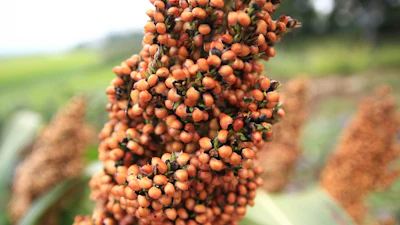
Iowa State University received a $750,000 Department of Energy grant to develop sorghum crops that resist lodging, or stalk collapse from wind and rain, while maintaining their value as bioenergy feedstock. The research team is creating a digital twin tool called TITAN that uses genetics, biomechanics, and AI to design ideal plant types and accelerate crop breeding faster than traditional methods.
- Iowa State leads a $750,000 one-year DOE project under the Genesis Mission to reduce sorghum lodging without compromising bioenergy value
- Lodging occurs when plant stalks bend or fall over in wind and rain, making harvest difficult and reducing crop viability
- The challenge: stronger stalks don't automatically make better biofuel feedstock, requiring balance between standability and processing value
- TITAN (Tokenized Integrated Twin for Agricultural Resilience) is a digital twin framework that links plant genetics to field performance and predicts biological traits at molecular and whole-plant scales
- Results will be released through open-source platforms and could eventually transfer to other crops, traits, and biological systems
Iowa State University researchers are leading a one-year, $750,000 U.S. Department of Energy project to make bioenergy sorghum more resistant to lodging without reducing the crop's value to biorefineries.
The university said in a Tuesday announcement that the work is one of four projects its scientists are leading under the department's Genesis Mission, a national initiative aimed at accelerating advances in energy, scientific discovery and national security. The awards were announced this summer in Washington.
Maria Salas-Fernandez, a professor of agronomy, is the lead investigator. Lodging occurs when stalks bend, buckle or fall over in wind or heavy rain, often making harvest difficult or impossible.
"We have made a lot of progress in developing sorghum as an effective bioenergy crop," Salas-Fernandez said. "Our main goal for Phase I of the Genesis Mission is to eliminate sorghum's lodging problem."
Standability versus processing value
The project builds on Salas-Fernandez's earlier research to produce hybrids that deliver high biomass yields by improving sorghum genetics adapted to northern latitudes.
The difficulty is that a stronger stalk is not automatically a better feedstock. Part of the challenge, Salas-Fernandez said, is making the plant more lodge-resistant without hurting its value for bioprocessing.
"This is important because many times when you try to solve the lodging problem, you can change some characteristics that result in problems for the biorefinery," Salas-Fernandez said.
Those characteristics reflect interactions among genomics, cell wall chemistry, plant tissue architecture and environmental forces, according to the researchers. The team said it is keeping in mind the needs of both farmers and the processors who are the end users.
Building a digital twin
To weigh those factors together, the team is developing a framework called the Tokenized Integrated Twin for Agricultural Resilience, or TITAN. The university describes it as a super intelligence tool meant to predict biological traits by linking genetics to plant performance and to design an ideal plant type for a given trait.
Salas-Fernandez said her team already knows how its genetically diverse bioenergy sorghums grow, how much they yield and what they are made of. Understanding lodging requires far more detailed stalk data collected at the same time and under the same conditions, and those datasets are expensive and slow to obtain.
The project will use existing data while collecting biomechanical, chemical and nanoscale data on a small set of plant materials to feed the models and create a digital twin.
Baskar Ganapathysubramanian, who holds the Anson Marston Distinguished Professorship in Engineering and works with the university's Translational AI Center, said the goal is a digital replica that connects what happens at the molecular scale to how a whole plant performs in the field.
"Imagine being able to virtually redesign a sorghum stalk, predict whether it will withstand strong winds, and simultaneously assess whether it remains suitable for producing bioenergy," Ganapathysubramanian said. "TITAN aims to bring these capabilities together, allowing us to explore plant designs much faster than traditional breeding and experimental approaches alone."
What comes next
A key objective of the first phase is to demonstrate what tools such as TITAN can do. The project will release its products as reusable models through the American Science Cloud and Transformational SI Models Consortium open-source platforms, according to the university.
"This is foundational research, but it is meant to have clear impacts over a relatively short time, to develop a faster and more cost-effective way to design crops that are both resilient in the field and valuable for biorefining," Salas-Fernandez said.
If the work succeeds, she said, the framework should eventually transfer to other crops, traits and biological systems.
Other collaborators are Pranav Shrotriya of mechanical engineering and Anwesha Sarkar of electrical and computer engineering, both at Iowa State, and Bryon Donohoe of the National Laboratory of the Rockies. The university did not say when first-phase results are expected or what a second phase would fund.