.jpg?auto=format%2Ccompress&crop=faces&fit=crop&h=48&q=70&w=48)
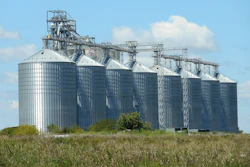
Every year, the harvest seems to somehow keep getting larger, and export sales are more often delayed or put on hold, requiring more grain to be stored for longer periods time.
That leads to a challenge for grain elevators — what do you do with all this grain? Turning producers away leads to potential costumer relations issues, and can lead to them storing more grain on the farm. But the old method of creating a ground pile and then selling that grain as soon as possible is easier said than done, and temporary ground piles can become more permanent features.
Throughout the past 10 years, nontraditional grain storage methods such as covered ground piles, hoop buildings and automated aeration systems have evolved dramatically, transforming from emergency fixes into strategic, permanent solutions that rival conventional bins and silos.
Non-silo or steel bin storage was once seen as a last resort during bumper harvests, often associated with quality degradation and high labor costs. Today’s innovations challenge that perception, combining sophisticated automation, superior monitoring and engineered structures that deliver cost savings and greater operational efficiency.
Covered ground piles go from temporary to strategic storage
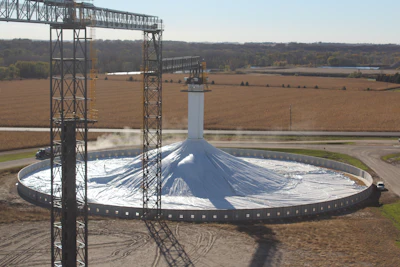
Covered ground piles historically suffered a poor reputation due to spoilage, shrinkage and high labor demands. These piles, covered by tarps and aerated by continuous fan operation, often led to moisture loss and grain quality issues. However, new technologies have addressed these challenges.
Advanced fan controls now automatically adjust speeds based on weather conditions, lessening energy use and minimizing shrinkage. Temperature and carbon dioxide sensors give real-time insight into grain conditions, helping managers detect hot spots early. Remote monitoring via mobile and desktop platforms enables oversight without physical visits, cutting labor and improving response.
"In permanent silos, aeration is a precise process focused on cooling or warming the grain mass through calculated air delivery and run times," said Kason Scroggins, regional sales manager, Rolfes@Boone. "In temporary storage, that changes, as the fans serve a dual purpose. While they provide some conditioning, their primary role is to keep the tarp in place."
“Remote access via mobile and desktop platforms has transitioned temporary storage from a labor-intensive task to a more streamlined operation," said Ryan Moorman, general manager, Rolfes@Boone. "Managers can now monitor conditions and start and stop fans off-site, which drastically reduces the man-hours previously required for manual operation."
"It saves having employees constantly drive out to remote piles to check on them, are the fans running, are the correct number of fans running," said Brad Lansink, technical sales and service, Comco.
But beyond technology, the mindset around these systems is evolving.
"A lot of people think temporary storage is a simple storage solution that requires little thought or effort," said David Price, executive vice president, Warrior Mfg. "That is not the case. Temporary storage requires planning, a significant amount of labor and constant monitoring for the duration of the commodity being stored."
Price continued: "I always tell my customers, the more you put into your temporary storage system up front, the more you will get out of it. Surface coatings, drainage, monitoring systems, etc., all have up-front costs but also result in fewer losses."
These advances allow covered ground piles to function not as stopgaps but as cost-effective, long-term options, which are crucial as permanent storage costs rise and space shrinks.
Hoop buildings are a permanent, grain storage solution
Hoop buildings have long been misperceived as inferior, temporary storage. Yet improvements in design and technology have made them highly competitive with steel bins and concrete silos for permanent storage.
"In the past, there was a common misconception regarding Macon buildings that they were viewed as an inferior way to store grain," said Craig Janssen, administrative director at Macon Construction. "Fast forward to today, and more and more people are realizing that it is a smart and cost-effective solution for their permanent grain storage needs.”
"They eliminate the ongoing cost of replacing bunker covers every year," Janssen said. "If power is lost due to a storm, you lose the air suction and could lose the covers, exposing your grain to the elements. You reduce the risk of shrinkage, and ground piles have much higher reclaim costs, which always impacts the bottom line."
Hoop buildings can incorporate positive aeration systems identical to traditional silos, with options for in-floor or above-floor air delivery tailored to customer budgets and needs. Automated sweep systems reclaim up to 97% of grain, improving recovery rates, speed and labor efficiency.
"Yearly maintenance is simple and normal, including greasing conveyors and tightening of the ratchets," Janssen said. "Macon buildings are very low maintenance, which is another selling point to customers looking to reduce their labor costs."
With a construction timeline of four to six months depending on the project scope, proper advance planning is critical.
Smart aeration and monitoring revolutionize quality control
Automation and real-time monitoring have changed the viability of grain quality management across nontraditional storage solutions. Grain spoilage and shrinkage once demanded constant manual supervision; today, integrated systems minimize risks while optimizing energy use.
Advanced fan control systems dynamically adjust speeds, cutting electrical costs and limiting moisture loss. Temperature and carbon dioxide sensors form a comprehensive awareness network, providing early warnings of grain hot spots. This data-driven approach helps managers intervene proactively rather than reactively.
"The integration of advanced fan control systems has been a game-changer," Scroggins said. "By altering fan speeds based on ambient weather conditions, managers can significantly reduce electrical costs and minimize shrinkage."
Scroggins continued: "However, it is important to remember that temporary storage is, by definition, a short-term solution. The most effective way to guarantee quality is to prioritize the reclamation of the grain; do not leave inventory on the ground any longer than absolutely necessary.”
The major operational advantage of these technologies is reducing labor requirements and enhancing oversight during critical unmanned periods.
Preparing for the future of grain storage
The defining change in grain storage is a move away from reactive, crisis-driven solutions to proactive, integrated storage planning. Elevator operators now recognize that temporary storage often becomes permanent, demanding robust, reliable systems designed well in advance.
“Our customers choose to look at it as an investment in a long-term asset," Price said. "Therefore, we provide solutions to meet their specific needs. Planning for this should be done during yearly capital planning meetings, not four to six weeks before harvest.”
"I would advocate for a shift from a reactive to a proactive mindset," Scroggins added. "Too often, temporary storage is an afterthought triggered by a bumper crop. By treating these systems as a planned asset and consulting with aeration experts early, managers can ensure proper system design and timely delivery of components.”
As yields and harvest efficiencies continue to climb, the need for storage solutions that are scalable, efficient and maintain quality will intensify. The grain industry’s adaptation through automation, monitoring and innovative structures such as covered piles and hoop buildings positions it well for these challenges.