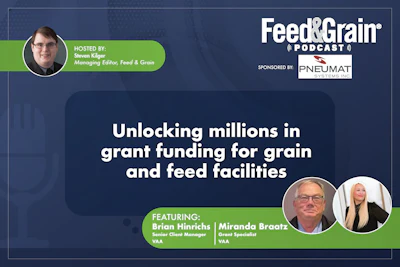
In this episode of the Feed & Grain Podcast, host Steven Kilger interviews grant specialists who’ve secured over $500 million for industry clients. VAA's Brian Hinrichs and Miranda Braatz share insider knowledge on navigating the complex world of government funding, from PIDP grants to state-level opportunities. They reveal how to leverage public-private partnerships, avoid common application pitfalls, and strategically position projects for approval. Learn why proper timing, thorough preparation, and telling your project’s story effectively can make the difference between rejection and receiving millions in funding. Essential listening for any feed or grain operation considering facility upgrades, expansions or modernization projects.

Steven Kilger: Hello! My name is Steven Kilger, I’m the managing editor for Feed & Grain magazine and the host of the Feed & Grain Podcast. I appreciate you joining me today as we dive deep into the issues affecting the feed manufacturing, grain handling and allied industries.
Today’s episode is brought to you by The BinWhip from Pneumat Systems. The powerful Dual Impact BinWhip removes the toughest buildup and blockages in industrial storage silos – without hazardous silo entry. Learn more today at binwhip.com.
Today I have two guests, Brian Hinrichs, senior client manager at VAA, and Miranda Braatz, grant specialist at VAA. Whether it be renovations, upgrades or greenfield sites, building modern grain and feed facilities is getting more expensive and can seem out of reach for many companies, even if building would help their operations. Applying and receiving grants offered by federal and state governments can mean the difference between going through with a needed project or putting it back on the shelf.
Brian, Miranda and I talk about what types of grants are available, how to apply for them, common mistakes and tips on getting requests approved.
As always, I hope you enjoyed the interview. If you want to help with the podcast or listen in a podcast app, please rate us and subscribe. If you’re listening online, sign up for the Feed & Grain Industry Watch. I work hard on it every day. It’s the best place to see new podcast episodes and stay up to date with news from around the industry.
With all that out of the way, thank you again for listening, and on to the show.
Hi, Brian. Hi, Miranda. Thank you for joining me today. Can you tell me about yourselves and what you do in the industry for readers who might not be familiar with your work?
Brian Hinrichs: My name is Brian Hinrichs. I’ve been working in the port harbor and river industry for almost 40 years, focused on federal and state grants for the last years. It’s been a real honor to work with grain companies and grain contractors.
I’ve had quite a success. In the last 15 years, I’ve secured over $500 million of state and federal money for my clients on the Great Lakes, the blue water coast and the Great Rivers.
Miranda Braatz: My name’s Miranda. I work with Brian, and I have a different experience from the public sector. I’m a former city manager. I’ve worked in federal, state and local grants over the last 15 years, as well as economic development incentives. Both Brian and I reside in Wisconsin, and both of us are also part-time farmers. So, we understand the industry and the listeners.
Kilger: You sound involved in every part of the process. It’s always nice to have Wisconsinites on the podcast. What brought you to my attention for this episode is the village of Henningpin. You helped them secure a $38 million PIDP grant. Can you talk about how you do the initial assessment? How do you know which grants are a good fit? When should people who are starting new projects begin thinking about grants? Should it be part of the process from the start?
Hinrichs: With our clients, the first thing we do is we want them to understand what they’re looking for money for. We put together an executive summary document that we at VAA call a two-page statement. We take two pages with graphics, and we describe the project, why they need it, what they want to build, what it’ll cost and who it’s going to benefit. Then we get it to the folks at the federal government. We’re going to talk about federal grants specifically right now. We get them to the folks at MARAD, and we arrange a phone call with the actual decision makers who review grant applications and decide whether they’re funded. We go through that, and we get them that two-page summary document.
We usually have about a half hour to hour phone call with the leaders at MARAD, and we go through the project. There are exceptional people at MARAD as far as being helpful and giving great feedback. For example, one time I had a project I called them about, and they said, “There’s no way we’re going to fund this. Brian, you know better.” But that’s very rare. In the case of the Henneman project, it was all green light. This sounds like a great project.
So, we got buy-in from those who approve the application. Second, we use a creative approach. A grant application is less a technical document and more about telling a story: What will this project do? Who will benefit? What efficiencies will result? Will local farmers, with this new market or port, get 4 or 5 cents a bushel more?
That’s part of the story that we tell. We’ve done this same thing with all our grants, all the federal grants. Even if it isn’t with the USDOT MARAD, if with EPA or FEMA, we use that same process. That’s kind of our secret sauce in making sure the project fits the grant requirements and has a very high likelihood of success.
Braatz: Absolutely. Any listener with a multimillion-dollar project that can create jobs or help the economy should start thinking about federal grants a year or two in advance. Federal grants usually cover projects of $5 million or more. State grants cover projects between $250,000 and $5 million. There are also local grants and economic development incentives. If you are looking at federal grants, start the conversation early. Look for programs that your project or site may qualify for. There are usually several.
Your site or project may also qualify for planning money. That’s another thing to keep in mind. The earlier, the better. If you have just an idea for a project or an expansion, certainly something to keep in mind for federal grants within the long run. Federal grants take about two years from when you do the application to when you receive the funding and do the grant agreement and start building. So, you really want to think of that timeline with the federal grants, state grants within a year, and local grants and economic development incentives are much shorter. I do think grants are an opportunity for all your listeners at every level.
Kilger: At least for me, and I’m sure many others in the industry, there’s not much awareness about how many grants is out there, how many things might be available for you. Just knowing that you guys have a document with all of them there and can help put them in touch seems like an invaluable service for what sounds like money that is on the table if you’re willing to work for it. Especially with the Hingpin project, which has modernization elements that you might not think of – lighting, upgrade, electrical infrastructure, things that’ll help in their facility, but also their sustainability and efficiency, which are becoming more important in modern facilities. Are these factors in any grant proposals? Is there more on the table if you’re willing to start talking about sustainability goals for the environment?
Braatz: What we like to do is take a site or a client and analyze what their eligibility is at the federal, state and local level. Then we assemble that into a document that shows which federal grants they qualify for, to what extent, and what state and local ones. That narrows it down to the programs. Then we talk with the client about how do you have projects or are there community desires because of what we do with public-private partnerships? What are the community desires for a project that might fit this grant? That’s how you can find the most funding for projects. For example, if you have a community that desires more throughput at their site, that’s something that can be eligible for federal grant funding through a public-private partnership.
So, you really want to look at your site and see what grants you may qualify for, and then see what projects or desires the community has at that site.
Hinrichs: Specific to the sustainability issues – to be brutally honest, it was a much bigger deal in the previous administration. The current administration does not put as much emphasis on sustainability, whether it’s upgraded lighting or more high-efficiency lighting. The USDOT is very interested in efficiency and, as Miranda mentioned, jobs. So what we’re focusing on now is maybe a little different than we did before. We are very focused on how we can make this site, this port facility or this grain facility, more efficient? That puts dollars on the table and puts dollars back into the growers and the farmer’s hands or the producers, if they’re moving, if it’s a bean crushing facility and they’re moving bean meal or something.
As Miranda mentioned, throughput’s important, efficiency is very important, jobs created are very important with the current administration. To a lesser degree the greener elements that we were focused on in the past administration.
Braatz: I would add to that, Brian, anything that expands the economic footprint, if it’s a port project or sustainability project, if it can expand the economic footprint of the location, that’s the key as well to funding.
Hinrichs: Some good examples are The Port Milwaukee project. That project was going to be the first port taking Midwest grain and shipping it directly to Europe and North Africa without being moved by truck or rail to the east coast and then transloaded. The efficiencies that came out of that were huge. And MARAD presented two PIDP grants for that project. Another one is Galesburg, which is an inland grain facility, where the client had a unique approach, taking empty containers that would be moving back to the West Coast empty, and then putting on ships empty and going back to Asia. Filling those containers, although normally you would think it would be inefficient for such small volumes with grain or grain byproducts and then shipping those containers full back to Asia. It was just a no-brainer. It made so much sense.
The federal government fully funded that to the maximum amount, that project. It just emphasizes how efficient, no matter which side of the aisle you’re on in Congress, just makes sense.
Kilger: You can’t change politics, but it shows how you need to word things slightly differently depending on where you are and what you want. You need to focus on slightly different things, because ultimately, being able to ship grain out of the Port of Milwaukee to Europe is a sustainability project in a more environmental sense, too. It’s just how you kind of word these things to get the grants that you want. Beyond PIDP grants, what other federal state funding opportunities have you seen that feed manufacturers and grain handlers should explore? What’s out there that they might not have thought of?
Braatz: There’s a number of grant programs in rail that we help our clients with, and it’s an integral part to the overall formula of making that economic footprint. If you have rail around your site, that’s something that we specialize in helping fund. I would look at anything with economic development incentives and grants where you are creating jobs, doing anything in the workforce. That’s another area that we like to look at.
Hinrichs: On the federal level, just the BUILD grant is one that we used for the project where we were putting grain into containers and shipping them back to Asia.
Part of what we do too is for every grant, there is a match portion. Most federal grants, the most you can get is 80% and then you have to put in 20% of either in-kind or your own money. One thing we’ve had great success with is working with the states, which many times have similar programs, but the awards aren’t as much. But we can use state grant money as match for federal money and vice versa. Let’s pick a simple number, $10 million project, and we’re going to ask for 75% from the federal government, $7.5 million. And then we would go to the state program and ask for $2.5 million.
At the end of the day, the client has virtually nothing invested in the project. This is not just theory. I’ve done this with literally dozens of grant applications for my clients, where we leverage state against federal against state. If there’s a secret sauce to this, that’s one of the things that we do very well. As Miranda mentioned, giving back to the programs themselves, the Port Security Grant Programs to the Coast Guard. MARAD also has a Marine Highway Program. There are several. What we really suggest to a client, as Miranda mentioned earlier, is one of the first steps to tell us about your project.
Then we’ll go through our experience and always double-check about what’s out there right now. We’ll put together a matrix of what grants are available for that project, and we’ll score them. This grant we think has a really high likelihood for your project, and we’ll go down. Many times, we’ll give them 15 or 20 opportunities, but we’ll say these are the ones that you have the highest likelihood of success with. One thing that any grant manager does not want to do is write grants that they don’t think they are going to win. In our case, we work with a well-established engineering company, very well-recognized in the feed and grain world. We want to support our clients to bring money so that we can build great things.
Kilger: That’s really interesting. I didn’t know that about leveraging state versus federal, but that can be a game changer if you’re deciding on whether to go forward with a project to know that the cost involved might be considerably less than you’re thinking if you’re not considering your grant money at the time. It’s great that you guys have this service that you can help these projects move through these grant processes, because like most people, when I hear forms for any kind of government funding, my eyes kind of just gloss over. But Brian, you talked earlier about how it’s about telling a story. Can you go more in-depth about what strategies facilities can employ to make sure their applications stand out, especially for competitive grant dollars?
Hinrichs: We’ll probably talk about this more, but what the federal government does is issue a notice of funding opportunity, a NOFO, as we call it. In that note, that is where all of the specifics of what the granting agency is looking for are. Really doing a deep dive into some of the most boring reading you’ll ever do is really important, and that’s what we do for our clients, but really understanding what the federal government is looking to fund. What is their end goal? They don’t use the shotgun approach. They’re very laser-focused on what they want to fund, and we want to make sure that it all fits into that program.
Understanding early on that notice of funding opportunity and what that process is just critically important.
Braatz: First and foremost, forming your public-private partnership and having a great relationship with your public sponsor and being on the same page with your community and public sponsor for the grant for what you aim to achieve with the project in the community, whether it’s job creation, economic footprint expansion, things like that. Make sure to have very strong relationship with your public sponsor so that they’re supportive of the project. Because if that does not exist, then there’s no way to really go after any grants.
Kilger: That’s really interesting because that’s one of our first bits of advice for anyone who wants to do any kind of build or new building project is that community support is going to help you make the entire thing so much smoother. It’s one of the first things you should do whenever you want to build is get the community behind you because they can make it a nightmare if they’re not. Can you tell me more about what a public sponsor is? Who is that and how are they involved?
Hinrichs: The public-private partnership is very important. In fact, most federal grant programs do not allow money to go directly from the federal government to a private entity. They want it to go to some public sponsor. Typically, that public sponsor is a port, a city, a county, a village. The more local the better. That entity, by agreeing to be the public sponsor for this project, is going to benefit the local community or local economy because of the growth that’s going to take place, both long-term and full-time equivalent jobs, as well as the construction dollars. So initially, they are the entity that will submit the application. Down the road, they are the entity that MARAD will talk about port infrastructure development grants specifically for a minute.
MARAD would then sign the grant agreement and be essentially responsible for executing the grant and managing the grant. That said, all of that can be conveyed to the private entity that is going to benefit from the monies through contract and through MARAD. For example, Port Milwaukee was the applicant, and we worked with our client in MARAD and we were able to get most of the responsibilities conveyed directly to our client rather than having to go through Port Milwaukee, such as bidding, contract execution with contractors and vendors, permitting – all of that could go directly through our private client. It’s kind of a secret sauce that we’ve developed over the decades of putting together these public-private partnerships and the folks at the federal agencies understand it and welcome them, but it’s something that is not necessarily intuitive.
Braatz: I would also add the public benefit there. Really taking into consideration the public benefit that the partnership is providing, as well, when you’re creating that scope of work for your grant application.
Hinrichs: To expand on what Miranda just said, sometimes when we’re putting together one of these public-private partnerships and the public entity, we’ll always ask them, do you have an intersection that is close to this project site, or do you have a bridge, or do you need something paved that is associated with this project, and we’ll add that in to the scope of work, and so the actual applicant, the public entity, they can get a win out of that as well.
Kilger: It seems like there’s a lot to it. What are the common mistakes you see first-time grant applicants make? It seems like everything, from starting too late to not having the right partner, all kinds of seem on the table for things that could go wrong.
Hinrichs: We just talked about it, not realizing or not understanding how important having that public sponsor is and the process. Because let’s just say it’s the city of Jonesville that you’re going to have your public sponsor. Well, you can’t go to them three weeks before the grant application is due and say, would you be our sponsor? Because they have a process many times. They may have to go through a committee and then a full council meeting to get approval to do it. We encourage our clients to get a memorandum of understanding, something in writing, that the public sponsor is they’re going to see this through. The second part is, as I mentioned before, if you don’t read the notice of funding opportunity, you’ll miss something, you’ll make assumptions, and with federal grants, you can never assume anything.
You have to read what that funding opportunity involves. And if you’ve got questions, reach out to the funding agency and get those questions answered, and then keep those answers in a safe somewhere in case you need them later.
Braatz: I think one of the common mistakes I see is when you start talking about millions and millions of dollars in federal and state money and grants, it’s really easy for your listeners to get excited and have 10 projects lined up. I mean, we love that because we’re great at matching projects to which grants can apply for. But also, you want to be realistic. I think that’s one of the key things. If you have 10 projects, pick your top two. If you’re going to start out in federal or state grants, make sure you’re not asking for the maximum of million and you’re starting at the medium level.
You want to really be strategic and have a long-term plan for federal funding, really looking five years out, where you have your projects lined up, you know which grants you’re going to apply for, you’re in step with your public sponsor, and that’s really how you achieve federal grants at the multimillion dollar mark – being strategic about it and understanding that you absolutely have to follow every single line of that notice of funding to a T and comply as well with all of the federal, state and local compliance, which of course we have a specialist on staff who helps with that.
Hinrichs: The other thing is not understanding the benefit-cost analysis. In reality, 40 to 50% of the application being successful or not following the federal rules for doing your benefit cost analysis and knowing what ratio you need to have. At the end of the day, for every dollar the federal government gives you, there better be a return of at least a dollar. You would be surprised how many applications they get where the BCA analysis comes in. It’s a 0.8 rather than at least 1. At VAA, we have a Ph.D. economist who does that economic analysis for you. It’s not something you want to try to do on your own.
It just isn’t. But having a well-thought-out following all the rules of the federal government for that benefit-cost analysis and then making sure that you have that ratio is just so important. And because if you think about it, the reviewers sitting in Washington reviewing these grant applications, if they can have some numbers to stand behind in their decision, that’s just so important. And that BCA number gives those reviewers something hard and fast. It gives them a map that they can rely on when they say this is an application that should move forward for funding.
Braatz: I would add that we also help with the public and elected officials’ support. And you want to have support for all of your grant asks, not only in the letters of support, but after you submit a grant, you want to continue to have that public and elected official support. And we also help and create strategies for that.
Hinrichs: The other thing is the amount of engineering that goes into the project prior to submitting the application. The folks at MARAD and the other federal agencies get a lot of grant applications that are really good ideas, but really good ideas don’t necessarily have a really good scope, schedule and budget established. One of the things that we encourage our clients to do is get at least a 30% engineering completed for the project. That way, our budget, what we’re asking for, we can validate, the schedule we can validate, the scope itself, just what we can put into this that’s going to make sense and fit the criteria of the NOFO. And then there are some nuances. If you get federal dollars, the components have to be made in the United States under the Buy American clause.
So, understanding that and being able to state in the application that you have vetted and that you’ve confirmed that the ship loader, the conveyors can be sourced from suppliers that can provide them that are 100% American-made. And that’s part of what we do too, but many times our clients will give us budgets too, and then we have to go back and vet that to make sure that those are actually available. That’s getting in the weeds a little bit, but that’s very important too, and that’s a mistake. Some applicants will make where they’ll provide a budget and components are made in China or India, but if those components are made here, maybe they’re 20% more expensive, so that affects the budget and the amount that you would be asking for in the grant.
Braatz: And I would say the other mistake that we commonly see is clients giving up. If you submit for the grant one year, there’s a high likelihood, and we have example after example, that they’ll fund it in the second year when you submit. And if you do have a project and it’s good, and we’ve gone to all this effort to submit for a federal grant, most certainly you would want to see if that project would fit several grants instead of just one. So not only are you submitting year after year to the same grant program, the project. And of course, making any changes that we feel need to be made throughout the years to make sure that the project is eligible. But you want to submit that same project to several different grants to your chances. We say, “worst comes to worst is you get funded twice and then you must make a choice.”
And we love when that happens. But really, what you want to do is if you’re putting the time, effort and money into creating a grant application, it is really securing that project to submit for everything that it’s eligible for.
Kilger: Forgive me for going out on a limb here, but it seems like the biggest mistake you can make is trying to do this by yourself, not getting consultants, a team like VAA involved in the project. There’s a lot of ways that you can mess up and a lot of phases in the grant funding process that are more difficult than they seem to be just by looking at “apply for this grant” form.
Hinrichs: In the last round, we were able to secure about $78 million of federal funds for three projects. And a lot of that is understanding the process and understanding the players. I’ve been doing this for decades. The folks at MARAD will take my call. They will answer my questions very upfront. The folks at MARAD are just wonderful people to work with, as well as EPA and FEMA. But MARAD is just, I can’t say enough about how wonderful they are to work with.
Understanding the process makes a very big impact on the process. Also, there is nothing in our writing a grant that we don’t think is gonna win. Working with a team like ours or the handful of other ones out there, you want someone who has got skin in the game. Ideally, they’re an engineering company, not just a grant writing firm that understands all of the process, not just understands the grant program. Our ultimate goal is to build great things and bring federal dollars to the table to help build those things for our clients. That’s our real goal.
Braatz: In the worst-case scenario, you get the funds recalled, and I’ve been on a couple of those. It’s not fun. Everything is about compliance and eligibility. You really want to surround yourself with key experts who are well-versed in that. When you’re talking multimillion dollars, and that’s the type of environment we work in federal funds, you really have to understand what you’re about to get into, so to say.
Kilger: We’ve hinted all through the podcast. VAA has a very robust department to help your customers deal with this grant process. Can you tell me more about this department, what you guys do, how it’s laid out, and how you guys deal with VAA’s customers?
Braatz: We like to start early. If you have a site, a location, an upgrade that you’re looking to do something that needs to be fixed that is what we would call large scale at the multimillion-dollar mark. That’s really when you want to start engaging us. We begin by just doing a simple scan of opportunities that would fit the project. And then we match it with grant programs that are eligible at the federal, state and local level. Then conversations ensue from there as to which grants to apply for and for how long.
We like to spread it out over a one-to-two-year strategy to maximize all funding. There may be several projects, there may be several locations. We have a team of sophisticated grant writers who write the grants, who help you submit them, and help craft public-private partnerships with your public sponsor. We have a team that also helps do grant management and compliance, which is important after funding. That’s really what we do.
We have an economist who handles that aspect of making sure that all of our economic data and numbers are correct. And then, of course, we’re engineers. So, we also have engineering. It’s really a one-stop shop, but it’s the one-stop shop for the right client that has projects and locations that fit these types of grants. And we found that your listeners in feed and grain are essentially the prime locations that have been the projects and the sites and the locations and the companies that have benefited from federal grants.
Kilger: If people want to find out more information about VAA and what you guys do, where should they go?
Braatz: They should go to the website at vaaeng.com, or you can always email us at [email protected]. We’re happy to take your questions. We’re happy to hop on a call and do a 15-minute consult and hear about what you have to say or answer anything that you might have about federal grants.
Kilger: Excellent. Thank you, guys, so much for joining me today and talking to me about this. It’s a really interesting subject that I think is going to become more important as things get more expensive and these facilities become most of the community projects. So, I really appreciate you hopping on and talking to me today. Thank you.
Braatz: Thank you for having us.
Kilger: Of course. And for anyone out there listening, thank you so much. Until next time, stay safe.