.jpg?auto=format%2Ccompress&crop=faces&fit=crop&h=48&q=70&w=48)
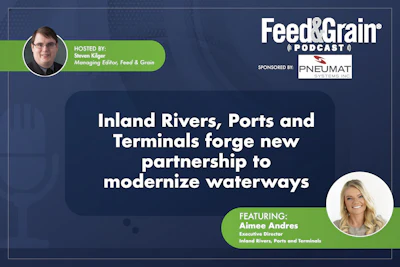
In this episode of the Feed & Grain Podcast, Steven Kilger sits down with Aimee Andres, executive director of Inland Rivers, Ports and Terminals (IRPT), to discuss a groundbreaking memorandum of understanding signed with the European Federation of Inland Ports. Together, they explore how this partnership aims to modernize inland waterway freight, expand commercial opportunities, and accelerate knowledge-sharing between the U.S. and Europe. From infrastructure innovations and marketing strategies to sustainability and cybersecurity, Aimee shares what the U.S. can learn from Europe, and vice versa, to strengthen our inland waterways and support the grain industry. Tune in to hear how these efforts could improve transportation efficiency, reduce congestion, and boost economic value for farmers, shippers and communities nationwide.

Steven Kilger: Hello! My name is Steven Kilger. I’m the managing editor for Feed & Grain Magazine and the host of the Feed & Grain Podcast. Thank you so much for joining me today as we dive deep into the issues affecting the feed manufacturing, grain handling and allied industries.
Today’s episode is brought to you by The BinWhip from Pneumat Systems. The powerful Dual Impact BinWhip removes the toughest buildup and blockages in industrial storage silos — without hazardous silo entry. Learn more today at binwhip.com.
Today my guest is Aimee Andres, executive director of Inland Rivers, Ports and Terminals. The IRPT recently signed a memorandum of understanding with the European Federation of Inland Ports to advance inland waterway freight by modernizing infrastructure, expanding commercial opportunities, and accelerating knowledge-sharing. We talk about what this memorandum of understanding is, what IRPT hopes to learn from Europe and how it will benefit the United States.
I hope you enjoy the interview. If you want to help out with the podcast and are listening to this in a podcasting app, please rate us and subscribe! If you’re listening online, sign up for the Feed & Grain Newsletter Industry Watch to see when new podcasts drop and stay up to date with all of the news from around the industry.
Now onto the show.
Kilger: Well, Aimee, thank you so much for joining me on the podcast today. I really appreciate it.
Andres: Certainly, thanks for having me. I’m really excited to talk with you. I think what we have going on is really going to impact a lot of your listeners and your readers.
Kilger: Yeah, definitely. It’s a big step forward, and we’re excited to talk about it, especially this day and age. Our inland waterways are so important. Can you just tell me a little bit about yourself and what you do at Inland Rivers, Ports and Terminals?
Andres: Yeah, so Inland Rivers, Ports and Terminals, our acronym is IRPT, because everyone has one. Some folks call us the ERPT. We actually just celebrated our 51st anniversary, so we’re not a new organization. We have members all around the United States. I’m super excited to announce that we even have some global terminal operators now that we’ve just added to the membership. Our members are comprised of the public ports, the private terminals, the barge lines, the boat companies, the shortline railroads, trucking companies, and most importantly, the shippers that use the waterways.
Kilger: It’s been a weird year in our industry with grain, and those relationships with our ports and our waterways are just so important to everything that our readers do for business. And you’re here today. I asked you to be a guest because you guys just gave this memorandum of understanding — memorandum, that’s a word — memorandum of understanding between you and the European Federation of Inland Ports. Can you talk a little bit about what the memorandum of understanding is and what’s going on with that relationship across the season?
Andres: Absolutely. We’re so excited because, like you said, our political climate right now and your readers and your listeners and our farmers, right? They have a lot of challenges getting their goods to market. The Inland Rivers provides that low-cost solution in transportation to get that grain to market. Well, where’s our market? A lot of the farmers are shipping overseas. So as IRPT continues to elevate the concerns and advocate for solutions, we wanted to hear from our European friends across the pond, if you will, to see how can we coordinate and cooperate and learn from each other?
Andres: So that’s how the memorandum started, the exploration of the memorandum started. Once we reached out to EFIP, because they have an acronym too, once we reached out to EFIP, we realized that they were just as excited as we were to explore this relationship. So we went back and forth with our leadership and both sides were just very excited to propel this forward. We ended up signing last month — or yeah, last month in October. And so we are in the throes of planning a visit over in Europe.
Andres: We’re going to take a delegation of interested IRPT members. We’re going to have some executive-level type of meetings just to discuss some of the topics that we want to explore, but also see some of the facilities that are moving the products along the European waterways.
Kilger: Yeah, well, that kind of answers my next question a little bit about what immediate actions are you guys taking? This trip sounds promising. What’s on the bill to be discussed once you’re over there?
Andres: So there’s a lot. I have an amazing team that works with me on staff at IRPT. There were a couple of days where we just gathered together and we’re like, really, what do we want to explore and learn from each other? What are we doing really amazing here in the United States that perhaps the Europeans would like to learn from us and vice versa? So a few of the things that we certainly — and we have three pages of topics that we want to explore. Each one of us is coming at it from a different aspect, whereas I may be looking at marketing and business development. Another one of my teammates might be looking at the maritime workforce and credentialing.
Andres: And another from the infrastructure aspect. One of the really exciting — and again, we have three pages of content that we want to explore — but in the United States, when we talk about measuring the economic impact and the value of our river system to farmers, to other shippers, to our communities, it’s always really challenging because we only have one base metric and that base metric is tonnage. That tonnage, though, doesn’t capture, say, the value of the good and the value of the decongestion on the interstate system.
Kilger: So…
Andres: I want to know how our European friends are calculating and measuring the value of their river system for transportation to their communities, to their economy, and to their lawmakers.
Kilger: Yeah, and that’s a big issue in ag, right? Because the fact is that our inland waterway system is our most efficient way to ship product. It’s the cheapest, maybe not the fastest, but it gets it there the best. Bulks are like that whole story of agriculture in our inland waterway systems. Our ports have placed such an important role in that as we explain to consumers about what we do. That message of getting more trucks off the road is a huge message for all of us. Because most people don’t care exactly where their bread is made, but they do care that they got stuck behind a bunch of grain trucks.
Andres: Not only do most people not care where the goods come from, but a lot of people don’t know that our rivers exist primarily for transportation of goods and people. So we are working really hard with our members to help elevate their voices within their communities, within their states, and then, of course, across the nation as a whole.
Kilger: You mentioned you were going to look into more business and commercial opportunities with the Inland Port Network and this partnership. What kind of stuff are you thinking? What investments, just ways that they’re designing their ports and doing their work? What kind of solutions are you looking for?
Andres: Yes. Marketing and promotion is always fascinating to me. How are they marketing their facilities to shippers? What are their shippers really demanding from their facilities? I know that when I was doing some research, I found a couple of different marketing campaigns that they had engaged in, such as cooperation in the corridor and into the hinterland. That seems to be a cross-marketing engagement between, say, a deep draft port of Rotterdam and a shallow draft port of Duisburg in Germany.
Kilger: So…
Andres: How is that cooperation in the corridor going? Is it a successful cross-marketing strategy? And how can we implement a successful marketing strategy like that in the United States with, say, the port of New Orleans and the port of St. Louis? There are a ton of different examples I could give there, but into the hinterland, it’s moving that product back into the heartland of the country. How did that campaign start? How is it going? Has it been successful? And how can we maybe replicate that over here in the United States? Were there any policies? Were there any incentives that helped promote and propel that forward?
Kilger: Yeah, especially when you think about it, Europe really does have a kind of similar — not exact same — system. Obviously, they’re different countries and things like that, but similar to states where you have different regulations across different communities. That question of how can we work together and not just be competitors, but think about the system as a whole over the individual competitiveness between ports seems like a really useful conversation for us to have, especially as the world is going to be more and more globalized. It’s important for us to figure that stuff out and how we can, as America, be a good trading partner and have a good fluid inland waterway system for everyone to use.
Andres: Absolutely. You mentioned the cross-country challenges or successes that they have in Europe. I’d love to explore that more. The operation, the maintenance of the actual infrastructure itself. Here in the United States, we rely so heavily on the Army Corps of Engineers…
Kilger: Being…
Andres: A federal operation and maintenance of our infrastructure, rather than having each one of our states maintain. What would that look like if each of our states had to maintain the waterways and the river system and the infrastructure? How are they really handling that across the pond and what can we learn from any challenges or even any successes that they’ve had with that?
Kilger: Yeah, definitely. And other opportunities beyond just our ports themselves or what they’re doing with sustainability, other innovations. Are you guys interested in swapping those ideas as well? I know sustainability isn’t quite the hot topic it was a year ago, but still, it’s something that seems like it should be important for us to consider as we go forward.
Andres: Yeah, absolutely. Innovative technologies are always going to be on our radar for efficiency purposes. When we can increase our efficiencies, we have the opportunity to increase our throughput, and then we have the opportunity to reduce the cost of doing business. So we’re always looking for those innovative technologies that are going to allow us to be more efficient and cost-effective. So we definitely want to look at that.
When we think of sustainability, though, it’s how are we going to sustain river transportation for years to come rather than looking at sustaining other aspects, right? Our bread and butter is how do we become more and more reliable and sustainable in the aspect of having our river available for continued growth?
Some of that does mean investments into the infrastructure — aging locks and dams, maintaining our channel. One of the things I want to explore overseas is their lock system. Are there innovative technologies in their lock system? Are we more innovative in terms of dredging than they are? I think there’s a lot that we could discuss there. I would love to know, are their locks or river infrastructure publicly operated? Are they privately operated? What does their model look like compared to ours and how can we learn from each other?
Kilger: Yeah, definitely. And it’s so nice to be able to see what they’re doing to modernize as well. We should be taking lessons from whatever the newest projects are, no matter where they are happening in the world. It also seems like a great chance to develop that relationship so we can all share technology and things as we build and modernize our systems.
Andres: Yeah, absolutely. We also look at navigation. We operate 24/7, 365 on our river system. Is that the same over there? We want to know about weather and seasonal challenges that might affect their operations. Maybe they’re exploring innovative technologies in case of ice, right?
What are they doing to combat seasonal effects on operations? Is that something we could maybe implement here? Maybe we are really leading the innovation there that we could share with them. I’d love to know how their river traffic is coordinated. Is it a centralized agency or is it decentralized and everybody coordinates their own river traffic? There’s just absolutely a ton — pun intended — that we could really explore.
One of the big things I definitely want to explore is resiliency. How does weather and seasonal water affect their operations? What kind of climate conditions raise challenges? Is it low water, high water, ice, etc.? And then, of course, resiliency. You always have to look at cybersecurity — security in general, but of course, cybersecurity. Are they implementing special technologies regarding cybersecurity and protection that maybe we should be exploring over here?
Kilger: Yeah, I mean, cybersecurity in the modern world needs modern solutions. So the sharing seems perfect. Like you said, everyone is dealing with climate issues — rivers being drier than normal or more flooding than normal. All that sounds great. You’ll have to keep us up to date with how these meetings go and what you guys learn because it sounds like a really exciting time.
Andres: Thank you. We’ll definitely keep everyone up to date, especially with some of the items we do learn. We’re a very big voice in Washington, as we have been for many years trying to implement different solutions to different challenges. We’ve been pretty successful in Washington, and I think following this exploration, we might have more to bring to the table to introduce to our members of Congress.
Kilger: Yeah, heck, maybe just good old-fashioned competition. Like the Europeans are doing it this way, that’s why we need to finally dredge these rivers.
Andres: Right, exactly. They’re doing public-private partnerships this way over there, so…
Kilger: Yeah, all sounds like a great plan. What else does IRPT have going on? Anything interesting?
Andres: Always interesting, yes. We’re getting ready to kick off our spring basin meeting season. Again, I mentioned we have members all around the nation. We divide them based on the river they work on, and we call that their basin. Right now we have 11 different river basins, and some of them span a large swath of river. For example, our Ohio River might have the upper and the lower; Mississippi, we have the upper and the lower. We have 11 different river basins. We gather all of our members each year at a basin meeting for free.
We say, “Hey, what are some of the challenges? Maybe it’s river operation or maintenance, etc.” Then we strategize on those solutions. We’re getting ready to kick that off in January, and that will run into May. Then we’re going to head over for a European summit in June. Then we’ll come back and have an annual conference Sept. 1-4 in Kansas City, Missouri. We definitely don’t let any grass grow under our feet. We’re always moving and working, providing massive benefits and resources for our members.
Kilger: Yeah, you do important work because Congress needs pushing. They need to know what’s going on. You guys are doing great work out there. For anyone who wants to know more or maybe volunteer or get involved in some way, where should they go? How should they reach out to you?
Andres: Yeah, absolutely. They can visit irpt.net. It’s real simple. irpt.net lets you learn all about us, but more importantly, learn about all of our members. We have this beautiful mapping system where we’ve mapped out all of the transload facilities in the United States. It’s a really great tool for shippers to use if they’re looking for an origination or destination transload facility. Use the map.
It is not member restricted or hidden behind a login wall. We’re just trying to make it easier for our shippers to find our members and really propel the river system forward to be the way of transport, if you will.
Kilger: It is our best option, so hopefully we get there soon. Thank you so much, Aimee, for talking to me today. I really appreciate it.
Andres: Thanks for having us. I really appreciate the invitation for sure.
Kilger: Oh, excellent. Hopefully you guys can come back soon and talk a little bit more about what you’re doing and how this memorandum goes, what we learned from it all.
Andres: You bet. Thanks so much.
Kilger: All right. And for everyone out there listening, thank you so much and stay safe.