
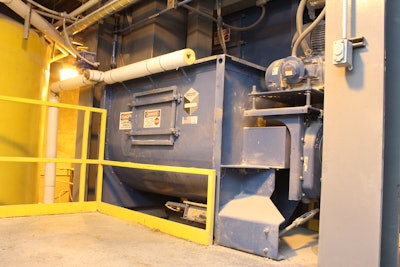
New feed mills, especially ones that operate at farm level (home mixing) are built every day, whereas older facilities keep being updated, especially those that pass from the analogue to the digital era.
The perennial question whether a vertical or horizontal mixer is better, or more economical for the short or long run, remains as strong as ever. Advocates of one or the other type tend to focus on the disadvantages of the other side, but I prefer to look at things from the opposite side. This enables me to match requirements to actual products instead of creating requirements to fit existing products, but that is an entirely other story. So, for now, I offer the following brief and non-exhaustive list of main advantages that I use to recommend one or the other type of feed mixers.
Advantages of vertical feed mixers
- Less expensive to purchase and operate. This is a general rule that can be broken by individual products in the market according to material and design.
- More readily available. A consequence of being used by smaller feed mills due to their lower cost is that there are many options to choose from in any single market.
- Occupy less space. In a crammed feed mill, where space is of premium, having a mixer with a smaller footprint can be seen as an advantage.
Advantages of horizontal mixers
- They offer a more uniform mix. This can be important for some species or classes of animals that receive smaller meals, whereas it might be of no significance for others.
- They can incorporate premixes of lower inclusion rate. Usually, a horizontal mixer offers the ability to mix products at the level of 1 kg/MT, as opposed to most vertical mixers that have a minimum of 3 kg/MT – again, a very broad rule of thumb.
- They have no or minimal feed carry over. They operate usually at an angle or have bottom trap doors that ensure complete discharge of the mixed mash, as opposed to vertical mixers that have a small but hardly avoidable residue.
As it can be seen from the above, the advantages of one type of feed mixer are the disadvantages of the other. Thus, the selection must be made based on the type of products being mixed. To this end, the following can be offered for consideration.
- Home mixers for farms. Here, we shall assume such animal farms handle only one species. If that is true, then it all about farm size. A small to medium farm usually opts for a vertical mixer for two reasons: (1.) They always strive to reduce costs as they can hardly focus on expanding production, and (2.) they invariable buy low-inclusion level products such as premixes locally; and these are usually up mixed, so they do not need the presence of horizontal mixers. On the other hand, large farms that can command large-volume purchases can buy at a reduced price certain micro-ingredients – for example a vitamin premix. In this case, the said premix is usually packed very tightly around 1 kilogram/metric ton, and this of course then requires more precision in home mixing. Thus, the extra cost of the vertical mixer can be offset easily by lower raw material cost.
- Mixers for local feed plants. Again, the above remain true, but most local feed plants focus on producing complete feeds for end-users. As such, they do not usually employ very-low inclusion level micro-ingredients and in most cases, they concentrate on one or two species. The only exception would be, in my opinion, the case of handling feed for sheep (minimal tolerance to copper) plus feed for monogastrics (usually oversupplied with copper). In that case, having no carry-over feed residue becomes imperative.
- Local premix plants. In certain markets, where home mixing at the farm level is common, it is also widespread the presence of local premix suppliers. These enterprises usually provide a package that includes everything but the cereals and protein source. They invariably produce premixes, of any size, for most species. It is my recommendation for such businesses to invest on a horizontal mixer, for all the above-mentioned reasons, plus it can become a point of marketing differentiation. Unfortunately, this is not frequently the case — for a number of reasons.
It is evident that the majority of small to medium feed plants prefer vertical mixers as a way of reducing costs. Although this may be the right way to go, there is a need for horizontal mixers when mixing uniformity and carry-over is a real concern. On the other hand, it is quite common for large(r) feed plants to opt for horizontal mixers as they have other and more diverse reasons that lead them to this decision.
Liquid application
Most users that utilize liquid raw materials also opt for horizontal mixers as the uniformity of mixing becomes more important. Such liquid materials can be oils or molasses, or more sophisticated products such as liquid vitamins or amino acids. The latter require even more precision to ensure a uniform spread throughout the mixed mash without pockets of feed being overfortified whereas others being devoid of any such products.
When inclusion of oils or molasses surpasses a certain level (around 4%), then most vertical mixers are unable to handle the excess liquid. In such cases, a horizontal mixer is a must, but the need for such high levels go with specialized products that are produced in specialized mixers that already have horizontal mixers.
In brief, the vertical mixer is the quick solution for the small farm with one species, that uses a premixed package of microingredients and adds only cereals and a protein source. Where more sophisticated product manufacturing, higher flexibility, and better quality-control are needed, then a horizontal mixer is the recommended option.