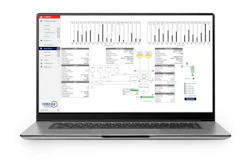
At GEAPS Exchange in Kansas City, Liam Cassidy, senior director of automation for Knobelsdorff, outlined how the company’s TerraKE MES platform and Truck Management System are redefining grain elevator operations through end-to-end automation and AI-driven intelligence.
Cassidy explained how TerraKE integrates truck intake, processing and outload into a single, centralized system that connects seamlessly with ERP, CRM and third-party software. By aggregating operational, financial and quality data into one platform, operators gain real-time visibility, proactive alerts and secure remote access.
With a built-in AI assistant capable of diagnosing faults and recommending solutions, TerraKE aims to eliminate silos, reduce downtime and optimize plant performance.
Transcript of interview with Liam Cassidy, senior director of automation, Knobelsdorff:
Elise Schafer, editor, Feed & Grain: Hi everyone, it’s Elise Schafer, editor of Feed & Grain. Today I’m at GEAPS Exchange 2026 in Kansas City, Missouri. I’m here talking with industry leaders, equipment manufacturers and suppliers of products and services for the commercial grain handling industry.
This edition of Feed & Grain Chat is brought to you by Knobelsdorff.
Liam Cassidy, senior director of automation, Knobelsdorff: Liam Cassidy, I'm with Knobelsdorff, senior director of automation.
Schafer: Can you walk us through the various functions in a grain elevator that can be automated with the Terra KE MES System?
Cassidy: So from truck intake all the way to outload, including integrating the Truck Management system, any third party softwares can all be integrated into one platform. The benefit of that now is you have a centralized platform where all your data is aggregated and you can improve production KPIs, production throughput and quality.
The other unique part of TerraKE is it can be customized to each individual customer needs. Now, we obviously have some foundational platform, but what's really unique is every customer in the grain industry has their own way of production, their own uniqueness, and we work hand in hand, really focused on the customer from the complete personas, from plant managers to operations, to finance, to quality, to really tailor a product that brings upside and benefit to your complete operations.
Schafer: Give us some examples of problems that this can solve for grain operators.
Cassidy: So with the TerraKE system, one big massive huge problem it can solve is the proactive alerting on it. So the system is constantly learning and monitoring how a plant should run in an optimal setting, and if it starts to see something go out of tolerance, you can get real time alerts even through a text message. It can give you an automated phone call. It can send you a message over teams to actually proactively start looking at what's going on in the plant and fix a problem before it causes any downtime or any issues.
Secondly, all of its data can be available on your phone. So it has the remote access, which is secure to your local IT network. And again, that's rather than waiting for that phone call, you'll constantly have that information in the palm of your hand, where you're proactively monitoring your plant, and then you're preparing to make sure that there is no downtime.
Schafer: Now, can you go over how companies with existing ERP systems, CRMs, how can they implement the Terra KE MES system?
Cassidy: So, what's really cool about TerraKE is we can talk to any system — ERP system, third party software — and we can move data in and out, but the real benefit is centralizing your operations and looking at the bigger picture, so not just focus on production, but how do we get KPIs from finance, from quality, and we centralize that to bring you one true source of data, and then ultimately that gives you the ability to run your plant more efficiently.
Schafer: Now, one of the most cutting-edge features is the AI assistant. Can you tell me about the value of that for end users?
Cassidy: Absolutely! What we're doing with TerraK is, you already have all this data in your plan. And traditionally, you would look for reports or static dashboards, and what we're doing is using large language models, or sometimes small language models, to be able to quickly digest that data and give you the information when you need it.
So, for example, let's say you have a downtime occurrence you can ask the AI what caused this downtime. Or let's say you're in a meeting with key stakeholders and you're like, I want to know what my production was for the last week. So, instead of going through your emails or putting up a dashboard, you can ask the AI, “Give me my production stats for two weeks ago between this specific date and time,” and it will give you that data instantly in the palm of your hand.
Now what's also really cool is bringing that one step further. I talked earlier about how KE can connect all different systems. So traditionally you get an alarm on your automation system and it will tell you there's a fault with a machine. Okay, great, you know there's a fault. With Terra KE and the built-in AI, it will now not only tell you the fault, but it will start to tell you the solution.
So it can pull in your plant SOPs and start to walk maintenance or operations team through — okay, I know there's a fault with this specific piece of equipment. It now will tell me exactly what the fault is, what the SOP is to repair it, if you have to order any maintenance equipment or if there's an additional part you have to order. It's all connected into maintenance systems, it's connected into your ERP for the financial side, so everything is holistically coming together.
And now you're actually streamlining your operations and you're not working in silos. That's a massive advantage with TerraKE.
Schafer: Well, thank you so much for talking with me today, Liam.
Cassidy: No problem.
If you'd like to see more videos like this, subscribe to Feed & Grain's YouTube channel, sign up for the Industry Watch daily eNewsletter, or search for videos on FeedandGrain.com.