
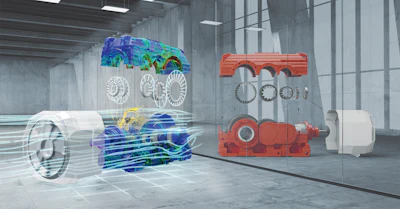
SEW-EURODRIVE’s Austin Burdette discusses heat challenges in grain handling gearboxes and how proper thermal management can reduce downtime and extend equipment life.
Brand insights from SEW-EURODRIVE
Grain handling systems rely on gearboxes to deliver the precise torque and speed required for conveyors, bucket elevators, mixers, and other equipment. But in these applications, heat is just as important a consideration as torque. High ambient temperatures, long duty cycles, and compact installations can lead to thermal buildup that affects oil life and component longevity.
In this Q&A, SEW-EURODRIVE’s Heavy Industry Gearing Product Manager, Austin Burdette, shares insight into the thermal challenges commonly encountered in agriculture and grain applications and how proper gearbox selection and thermal management strategies can reduce the risk of downtime and extend equipment life.
Q1: Why is thermal performance a critical factor in gearbox selection for grain handling systems?
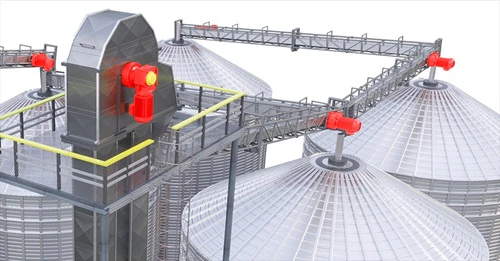
Example of SEW-EURODRIVE gear units installed in a Grain Silo Application.
Image courtesy of SEW-EURODRIVE.
Austin Burdette: In grain handling systems, gearboxes must do more than deliver torque; they also must manage heat. As gearboxes and motors increase in size, they generate more heat, but their ability to dissipate it doesn’t scale evenly. It’s like trying to cool a big engine with a small fan. The bigger the engine, the more heat it produces, but if the fan doesn’t grow with it, it can’t keep up. Likewise, modern gearboxes are more compact, with less surface area per unit of power, making convective cooling more difficult. To compensate, gearboxes can be equipped with thermal enhancements like shaft-driven fans, auxiliary fans, internal water-cooling coils, or external oil coolers.
Q2: What happens if a gearbox is thermally limited?
(i.e. if the gearbox’s input power is greater than its thermal rating)
Austin Burdette: The lubricating oil will be heated beyond its rated limit temperature, resulting in oil degradation over an expedited period of time. In mild cases, this means more frequent oil changes are required to avoid accelerated wear; in extreme cases, this means complete degradation of the oil and extremely low oil viscosity resulting in direct contact of meshing gear profiles and, ultimately, catastrophic failure of the gearbox, such as seal failure, bearing seizure, gear welding, and/or fracture.
Q3: What are the most common thermal challenges in agricultural and grain conveyor systems?
Austin Burdette: There are many thermal challenges and influencing factors for large gearboxes on agricultural and grain conveyor systems that should be taken into consideration:
- Direct sunlight: Direct sunlight (especially in locations with high irradiance) can decrease a gearbox’s thermal rating.
- Low ambient airflow: Stagnant ambient air can decrease a gearbox’s thermal rating.
- Proximity to heat source: Installation location and surroundings are critical to a gearbox’s thermal performance. For example, if the gearbox is installed near a furnace or kiln.
- Axial fan direction of rotation: Incline conveyor and bucket elevator gearboxes with backstops and axial fans may need fan or backstop repositioning if shaft rotation changes.
- Dusty environments: Grain applications can be dusty; gearboxes with oil-to-air coolers require air filters to be cleaned/replaced, or if filter-less, the heat exchangers to be cleaned regularly.
- Low ratios (high speeds): Conveyor systems running at high speeds and higher motor powers require cooling due to increased churning losses and bearing heat generation.
- Proper lubrication: Operators need to ensure they are using approved oil (GearOil by SEW-EURODRIVE), maintain correct oil levels, check regularly for contamination, and replace oil per the catalog’s oil life chart.
Q4: How do you properly size a gearbox for thermal capacity, not just torque, for a grain application?
Austin Burdette: At SEW-EURODRIVE, properly sizing a gearbox for thermal capacity starts with confirming that the unit can dissipate more heat than it takes in. This can be done using:
- catalog values with correction factors or,
- more accurately, through SEW-EURODRIVE’s internal thermal calculation tools, run by our application engineers.
We rely on validated simulations, but the accuracy depends on the quality of the application data provided. That’s where our engineering support teams come in; we work closely with customers to gather key inputs such as duty cycle, ambient temperature, mounting position, and power levels to ensure every gearbox is sized for both mechanical and thermal performance.
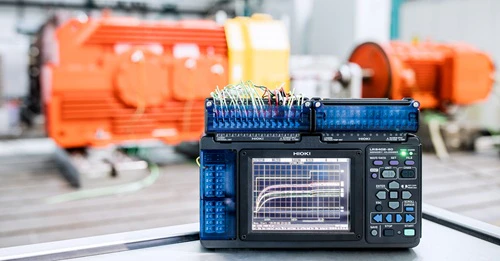
Thermal test stand featuring an X.e Series Gear Unit. Image courtesy of SEW-EURODRIVE.
Q5: What are the available solutions when the gearbox’s thermal limit is too low for the application?
Austin Burdette: Thankfully, SEW-EURODRIVE gearboxes can be specially engineered with components that greatly enhance their thermal rating:
- Shaft fans: Typically either radial, diagonal, or axial fans are affixed to the gearbox high-speed shaft.
- Motor-driven fans: Also called “auxiliary fans.” These are typically axial-type fans that have dedicated fan motors.
- Internal water-cooling coils: Water flow/pressure and cleanliness must be consistent. More common in high-temperature environments, such as metal production and smelting.
- External heat exchangers: oil‑to‑air or oil‑to‑water; support cooling, but water flow and cleanliness must stay consistent, especially in high‑temperature environments.
Q6: How does thermal management tie into predictive maintenance for gearboxes in agriculture?
Austin Burdette: Thermal conditions have a direct impact on how accurately we can model gearbox life and schedule maintenance. Predictive maintenance relies on real-world data to estimate when service is needed, but those predictions only hold true if the gearbox stays within its expected thermal range. Excess heat leads to oil breakdown and reduced film strength between gear teeth, which increases wear and risk of failure.
At SEW-EURODRIVE, we use advanced modeling tools backed by field data, and our engineering team works closely with customers to make sure thermal conditions are understood and managed. When thermal limits are respected, predictive maintenance becomes a reliable tool to plan downtime, reduce risk, and extend gearbox life.
Q7: Any additional information you would like to share on this topic?
Austin Burdette: SEW-EURODRIVE has nearly 100 years of gearing expertise and an incredible global network of gearing experts who are eager to assist you with determining your optimal solution. Never hesitate to reach out.
About the Expert
Austin Burdette is the Product & Business Development Manager for Heavy Industry Gearing at SEW‑EURODRIVE, USA. Austin has been with SEW-EURODRIVE for six years and has a B.S. in Mechanical Engineering from Clemson University. Austin brings a strong technical background in power transmission and a deep interest in continuous learning. Whether studying heavy industrial drive systems, emerging AI technologies, or hands-on craftsmanship, he applies the same curiosity and problem-solving mindset to helping customers find the best engineering solutions for their applications.

About SEW-EURODRIVE
For over 95 years, SEW-EURODRIVE has been known as the standard in gearmotors and drive systems. With our diverse portfolio of tough and reliable drive and automation products, we move countless applications in every industry. With 17 production plants and 81 Drive Technology Centers in 52 countries, we’re at your service on every continent and in every corner of the world. Despite our global reach, SEW-EURODRIVE remains family-owned, ensuring long-term vision, strong values, and a commitment to excellence.
With a manufacturing facility and 5 assembly centers in the U.S., SEW-EURODRIVE delivers a wide range of power transmission and motion control systems, including gear units and gearmotors, inverters and controls, large industrial gear units, and drive maintenance and repair services.
Click below to learn more:
SEW-EURODRIVE. Driving the World™
SEW-EURODRIVE, Inc.
220 Finch Road
Wellford, SC 29385
(P): (864) 439-7537
[email protected]
www.seweurodrive.com